Fiberglass Coupling Types for GRE / FRP Line Pipe
A fiberglass coupling is the joint hardware that joins GRE or FRP line-pipe sticks — adhesive-bonded sleeves, threaded couplings, or mechanical couplers — so the string seals, carries load, and matches your install method. This guide helps buyers pick the family before they RFQ; it is not a redo of the thread-joint RFQ page.
IFGS sources GRE / FRP pipe and joint kits from licensed partner factories in China and worldwide and handles spec confirmation, procurement and pre-shipment QC. IFGS has no factory of its own; it connects buyers to licensed partner factories in China and worldwide. Pair this types page with the live spigot joint buyers guide. For a deep thread-joint RFQ (fiberglass vs stainless vs without coupling), use Fiberglass Coupling on GRE Thread Joints. No fake certificate or monogram claims on this page.
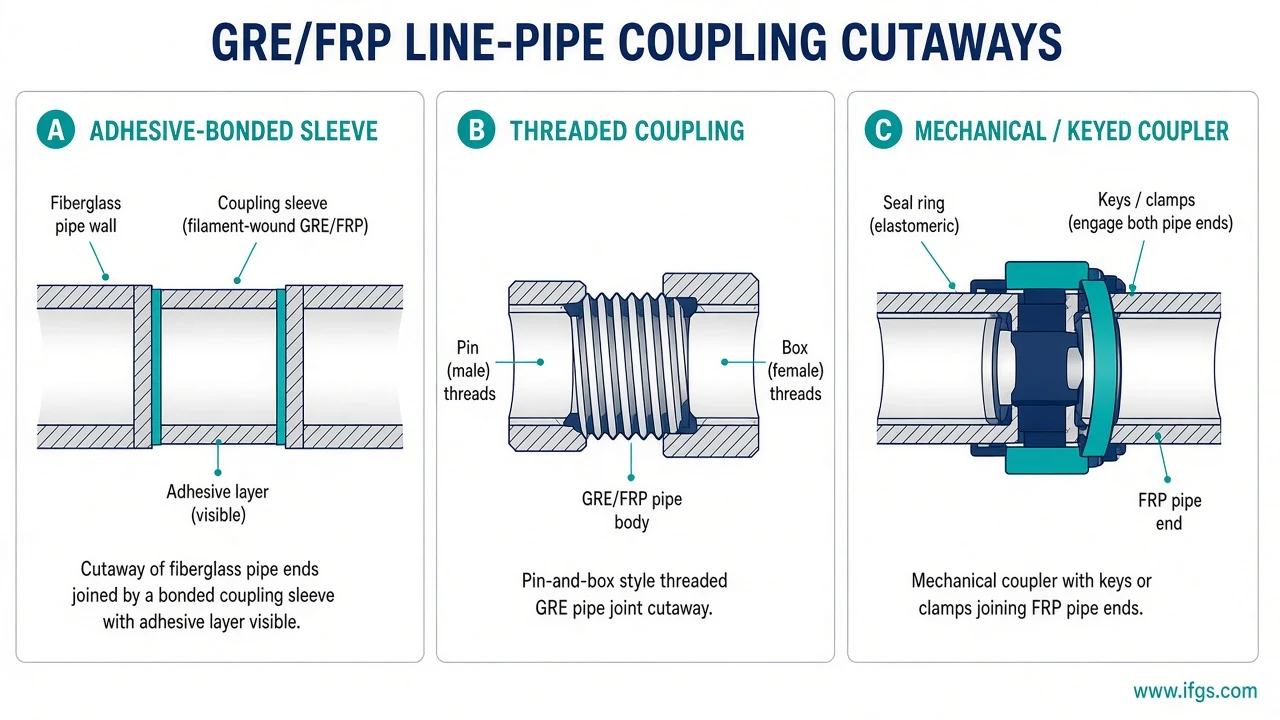
What “fiberglass coupling” means on a GRE / FRP RFQ
On bid forms, fiberglass coupling, FRP coupling, and GRE pipe coupling are often used loosely. In practice you are naming a joining system: how pipe ends meet, how the joint seals, whether it is restrained, and what install skill and cure or make-up procedure the field needs.
Spigot / bell-and-spigot and double-bell couplers are covered on the D1 spigot guide. This page focuses on three families buyers mix under the word “coupling”: adhesive bonded (cemented), threaded, and mechanical.
Type 1 — Adhesive bonded (cemented) joint
An adhesive bonded joint chemically bonds pipe ends (often with a sleeve or laminated build-up). On IFGS catalog language it is a restrained path; published headlines list up to about 1,200 mm and up to about 70 bar — not a claim of 70 bar at 1,200 mm combined. Request the adhesive procedure, cure window, ambient limits, and inspection steps before you freeze the RFQ.
Fits when: the project spec already calls for bonded / laminated construction; you want restraint without thrust blocks; crews can control surface prep and cure. Watch: cold weather, dust, and short cure windows; unequal bids often hide missing adhesive kits and witness points.
Product entry: Adhesive Bonded (Cemented) Joint.
Type 2 — Threaded coupling (GRE thread joint)
A threaded fiberglass coupling completes a pin-and-box style make-up with a full fiberglass sleeve (or a stainless / without-coupling sister). IFGS thread-joint headlines: up to about 26 in and up to about 3,000 psi (200 bar), with API 5B 8rd / 4rd language on those product pages; restrained; no thrust blocks; aboveground or buried.
Fits when: the isometric prefers thread make-up; you need restraint without thrust blocks; mixed aboveground / buried segments. Watch: naming fiberglass vs stainless vs without coupling; thread form; diameter/pressure near catalog ceilings.
Do not rebuild that RFQ here — send buyers to Fiberglass Coupling on GRE Thread Joints and Thread Joint with Fiberglass Coupling.
Type 3 — Mechanical coupling
Mechanical fiberglass / FRP couplings cover keyed, clamped, or other mechanical engagement systems that are not adhesive cure and not a standard GRE thread sleeve. On IFGS catalogs, rubber-seal bell-and-spigot and double-bell coupler paths are the common “mechanical / push-fit style” cousins — often non-restrained and thrust-block dependent unless you choose a locked sister.
Fits when: you want install speed without adhesive cure; large OD needs a separate coupler sleeve; deflection and flexibility matter. Watch: restraint vs civil thrust plan; spare gasket / coupler kits; do not write “coupling or equal” without geometry.
For spigot vs double-bell geometry, use the spigot joint buyers guide.
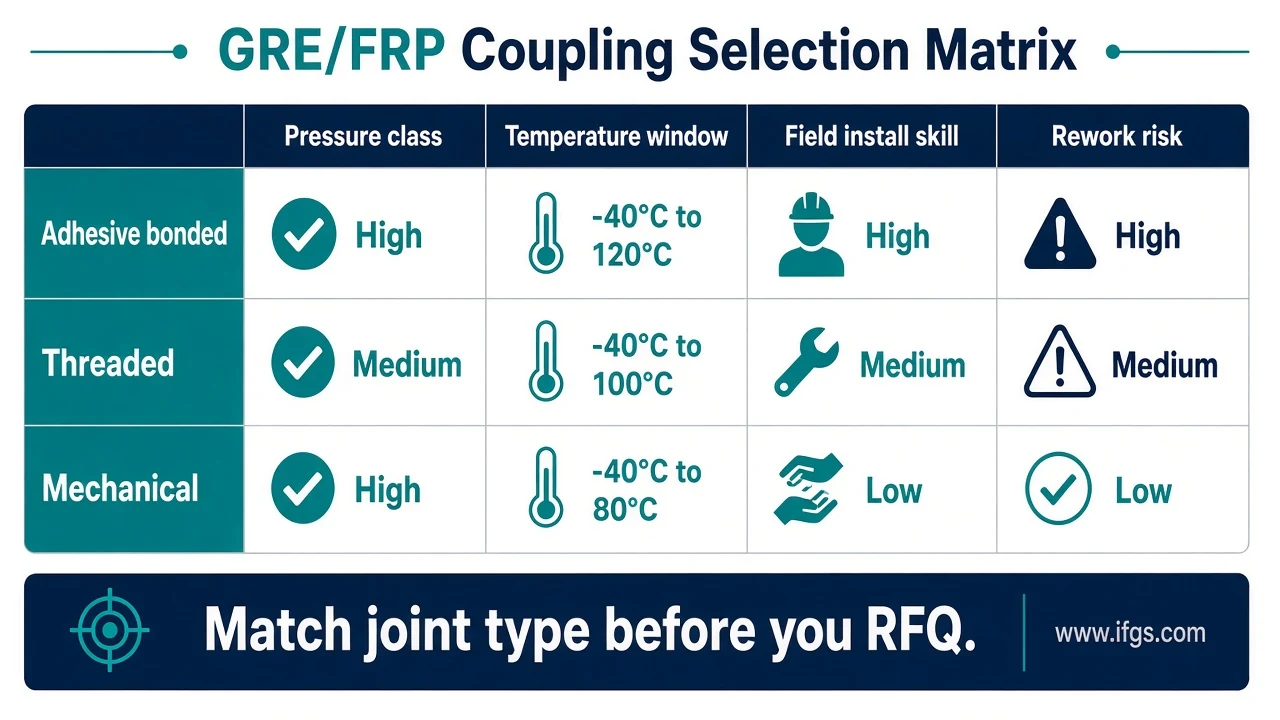
Selection matrix: pressure, temperature, install skill, rework
| Buyer question | Adhesive bonded | Threaded coupling | Mechanical (spigot / double-bell style) |
|---|---|---|---|
| Typical pressure / size headline (catalog) | Up to ~1,200 mm; up to ~70 bar (not combined) | Up to ~26 in; up to ~3,000 psi (200 bar) | Spigot ~1,400 mm / ~50 bar; double-bell ~4,000 mm / ~40 bar |
| Temperature / cure sensitivity | High — adhesive cure window and ambient matter | Make-up procedure; less cure-dependent | Seal elastomer and install temp per joint procedure |
| Field install skill | Prep + adhesive discipline | Thread make-up / torque or turn count per ITP | Alignment, lubrication, deflection limits |
| Rework risk if rushed | High (bad bond = cut-out) | Medium (gall, seal damage) | Medium (seal groove / edge damage) |
| Restraint / thrust (typical catalog) | Restrained | Restrained; no thrust blocks | Often non-restrained unless locked |
| Best next page | Adhesive bonded product | Thread RFQ blog | Spigot buyers guide |
Catalog headlines are starting points, not combined ratings. Ask for size-specific drawings and datasheets. Standards letters for rigid GRE/FRP strings often sit with API Spec 15HR / 15LR; spoolable RTP under 15S is a different family — do not paste 15S end fittings into a GRE coupling RFQ.
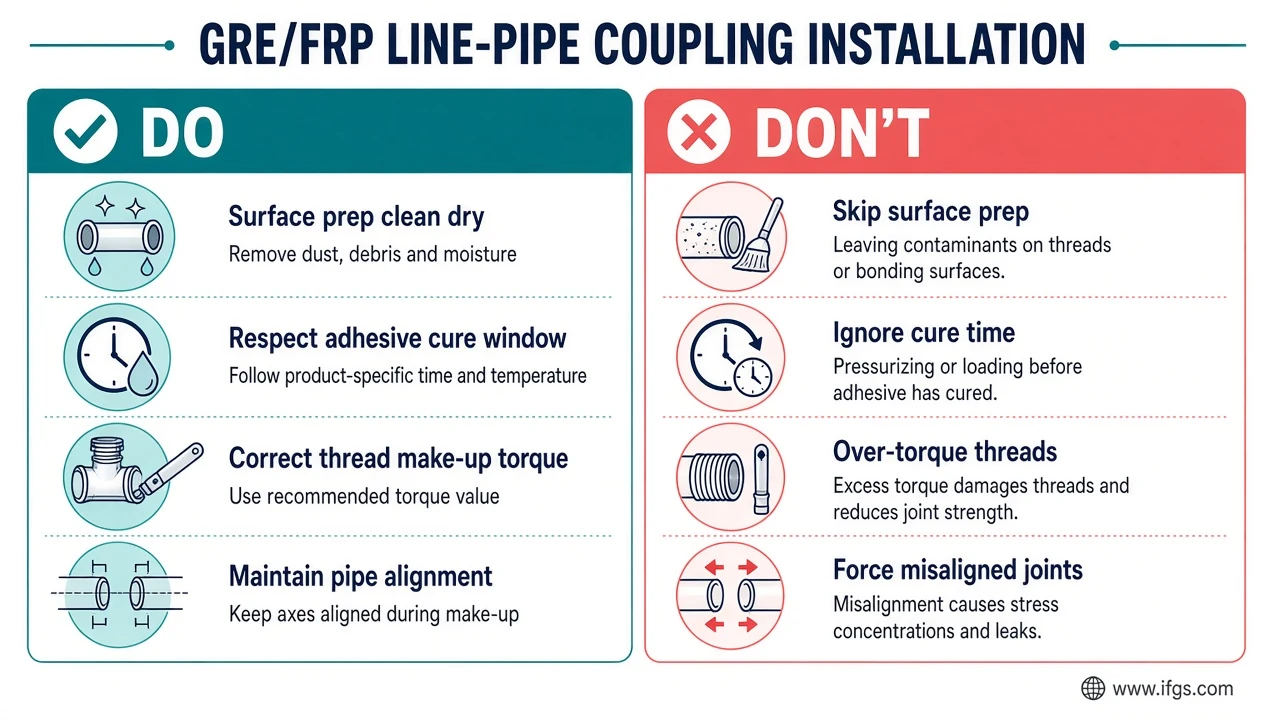
Install pitfalls that break unequal bids
- Do: name the coupling family and geometry; attach joint procedure; protect ends in shipping; clean and prep per the adhesive or seal kit; respect cure or make-up windows before pressure.
- Don’t: write “fiberglass coupling or equal” without family; improvise steel gasket practice on GRE seals; ignore thrust blocks on non-restrained joints; mix 15S RTP fittings into a stick GRE RFQ; ask for price only and skip the datasheet.
RFQ field checklist
- Joint / coupling type — adhesive bonded, threaded (fiberglass / stainless / without), or mechanical (spigot / double-bell / other). Avoid bare “FRP coupling.”
- OD / ID or DN and design pressure / temperature as project fields.
- Fluid — produced water, injection, oil, chemical; note H₂S / CO₂ / aromatics if known.
- Adhesive system (if bonded) — kit name, cure window, ambient limits, inspection steps.
- Thread form (if threaded) — e.g. API 5B 8rd vs 4rd when your audit set cares.
- Install mode — buried vs aboveground; restraint / thrust plan.
- QA documents — joint datasheet, ITP outline, install procedure, material certificates for the construction offered.
- Quantity and logistics — coupler count, spare seals/kits, destination, delivery window.
How IFGS works on this order
IFGS is a sourcing and QC partner for GRE / FRP / RTP oilfield equipment: it connects buyers to licensed partner factories in China and worldwide and handles spec confirmation, procurement and pre-shipment QC. Use this types page to lock the coupling family; use the thread RFQ page and product datasheets for numbers. IFGS has no factory of its own and will not invent monograms.
Next step
Contact us / request documents
· IFGS AI
· Spigot joint guide (D1)
· Thread-joint RFQ
FAQ
Is every fiberglass coupling a thread joint?
No. Buyers also mean adhesive-bonded joints and mechanical couplers (including spigot / double-bell styles). Name the family before you compare bids.
Should I use this page instead of the thread RFQ blog?
No. This page is types + selection. When you already know you want a GRE thread joint with a fiberglass (or stainless) coupling, use the dedicated RFQ article.
Does IFGS have its own factory?
No. Shipped from the licensed partner factory selected for your order.
Related products: thread joint with fiberglass coupling, double-bell coupler, rubber-seal spigot joint, and API 15LR GRE tubing.