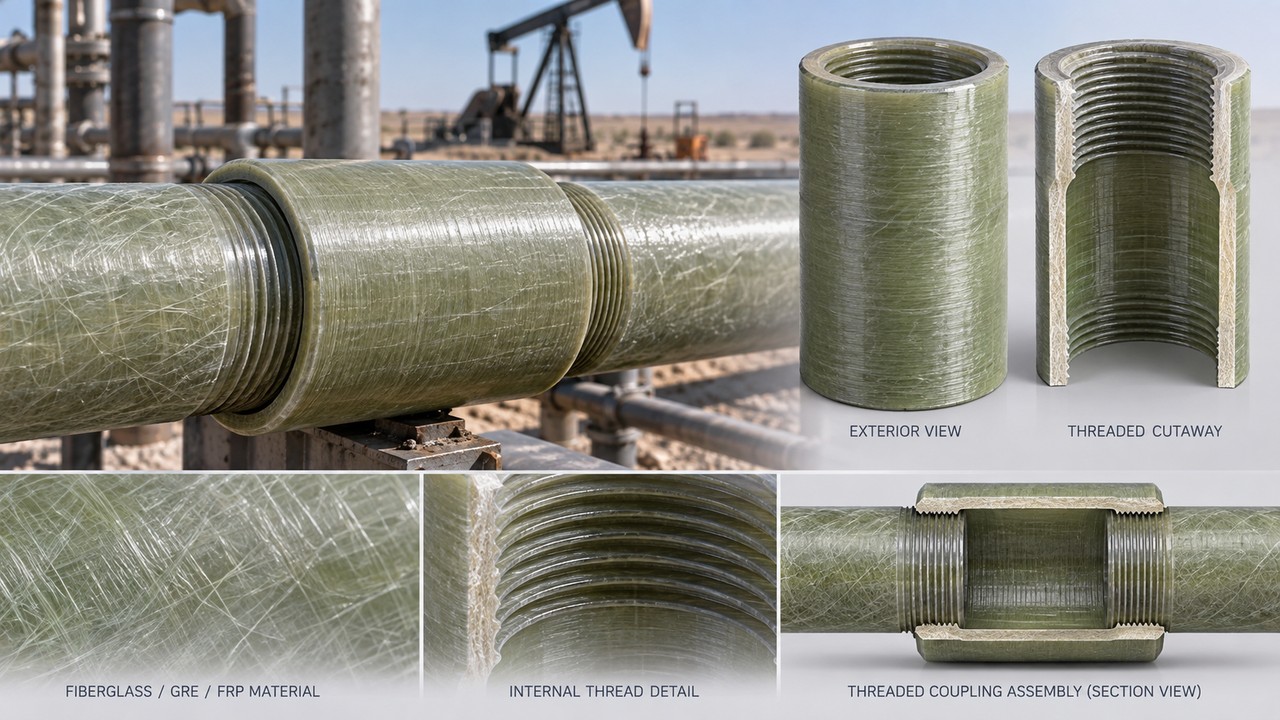
When your RFQ names a fiberglass coupling on a GRE thread joint, you are choosing how your string couples, seals, and carries axial load—not a glossary entry. On oilfield and geothermal lines where steel corrodes, that choice steers diameter, pressure class, API 5B thread form, and whether you want a full fiberglass sleeve. This page walks you through what you should lock into your inquiry so your quote matches how IFGS builds these joints in Dongying.
What a fiberglass coupling means on your GRE thread joint
On IFGS GRE thread-joint products, a full fiberglass coupling is the sleeve that completes a threaded connection between your pipe ends. The money-page envelope lists sizes up to 26 inches and pressure up to 3,000 psi (200 bar), with API 5B 8rd and 4rd thread forms. The joint is restrained, does not require thrust blocks, and installs aboveground as well as buried. Use that frame when your scope says “fiberglass coupling” without naming the product family.
You should treat “fiberglass coupling” on a bid form as a joining-system decision. Your fluid, installation mode, and sleeve preference (fiberglass vs stainless vs none) decide which sister product you put in the RFQ.
Fiberglass vs stainless vs without coupling: the decision table for your RFQ
Use this table when you shortlist the coupling option before you ask for a datasheet or quotation:
| Decision factor on your project | Thread joint with fiberglass coupling | Thread joint with stainless steel coupling | Thread joint without coupling |
|---|---|---|---|
| Catalog size / pressure (IFGS) | Up to 26 in; up to 3,000 psi (200 bar) | Up to 26 in; up to 3,000 psi (200 bar) | Up to 26 in; up to 3,000 psi (200 bar) |
| Coupling style | Full fiberglass coupling | Stainless steel coupling | Without coupling |
| Thread / standards callout | API 5B 8rd and 4rd | API 5B 8rd and 4rd | API 5B 8rd and 4rd |
| Restraint / thrust | Restrained; does not require thrust blocks | Restrained; does not require thrust blocks | Restrained; does not require thrust blocks |
| Installation | Aboveground as well as buried | Aboveground as well as buried | Aboveground as well as buried |
| Best when your layout… | Wants a corrosion-matched fiberglass sleeve | Prefers a stainless coupling on the same envelope | Does not use a coupling sleeve |
If you want an all-fiberglass sleeve, stay on the fiberglass-coupling path. If you prefer metal, evaluate the stainless sister. If your design skips a coupling, use the without-coupling sister—and say so before you freeze the RFQ language.
For your primary fiberglass-coupling option, open Thread Joint with Fiberglass Coupling.
When your design needs a metal coupling on the same envelope, review Thread Joint with Stainless Steel Coupling.
If your scope omits a coupling sleeve, review Thread Joint Without Coupling.
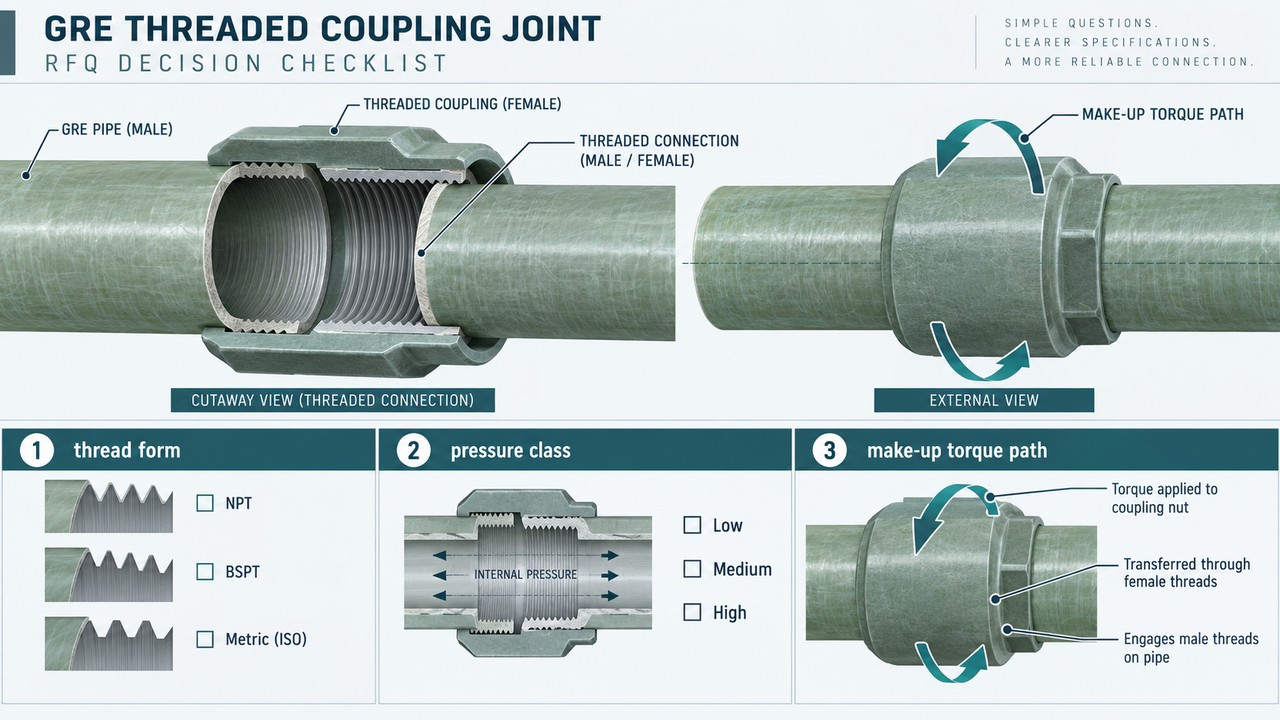
RFQ checklist: what you should send so the quote matches your line
Before you request a quotation, put these items in your inquiry so IFGS can return verified technical data:
- Product / joint type and quantity — fiberglass coupling, stainless steel coupling, or without coupling; say if you still need help choosing.
- Diameter and pressure class — stay inside the published envelope (up to 26 inches / up to 3,000 psi / 200 bar) or flag if your duty is outside it.
- Service fluid — produced water, injection, chemical, or other corrosive duty where GRE/FRP replaces steel.
- Buried vs aboveground installation — call out mixed segments explicitly.
- Standards you will audit against — for example, API 5B 8rd or 4rd; ask for the joint datasheet that aligns with your pipe standard set.
- Delivery window and destination — enough for a real manufacturing quote from Dongying.
IFGS states that verified technical data is available on request—so your RFQ should ask for the product datasheet by name, not only a unit price.
Where this joint fits on your oilfield or geothermal line
IFGS manufactures GRE and FRP pipe systems in Dongying for oilfield and geothermal service, and positions fiberglass where steel corrodes—produced water, injection, and chemical lines. You typically use a thread joint with a fiberglass coupling when you want a restrained threaded connection with a full fiberglass sleeve rather than a spigot, flange, or laminated joint. Stay inside the thread-joint family and decide fiberglass vs stainless vs without coupling with the table above.
Spec traps that slow your quote
Watch for these gaps—they usually send a fiberglass-coupling RFQ back with clarifying questions instead of numbers:
- You wrote “fiberglass coupling” but did not say fiberglass vs stainless vs without coupling.
- You omitted API 5B 8rd vs 4rd when your audit set cares about thread form.
- You listed pressure or diameter without checking the 26 in / 3,000 psi (200 bar) catalog ceiling.
- You mixed aboveground and buried segments without calling them out.
- You asked for price only and skipped the datasheet request IFGS invites on the product pages.
Clean those five items and your inquiry is ready for a real quote.
FAQ
What does “fiberglass coupling” mean for your GRE thread-joint RFQ?
For your GRE/FRP inquiry, a fiberglass coupling means a full fiberglass sleeve on a thread joint that mates your pin and box ends. On the IFGS money page, that product lists sizes up to 26 inches and pressure up to 3,000 psi (200 bar), with API 5B 8rd and 4rd options. You should name the coupling material and thread form in the RFQ so the quote matches your audit standards.
Are the three thread-joint sisters the same size and pressure for your scope?
Yes on the published catalog lines: fiberglass-coupling, stainless-steel-coupling, and without-coupling thread joints share the same headline envelope—up to 26 inches and up to 3,000 psi (200 bar), API 5B 8rd and 4rd, restrained, no thrust blocks, aboveground or buried. Your real decision is coupling material and layout preference. Ask for datasheets if your duty sits near those limits.
Do you need thrust blocks with a thread joint and fiberglass coupling?
IFGS states the thread joint with fiberglass coupling is a restrained joint and does not require thrust blocks. You can plan your civil scope without thrust-block work for this family, provided your RFQ stays inside the published product envelope. You should still confirm axial-load and routing details when you request verified technical data.
Can you install this joint aboveground on your project?
Yes. The product page states the joint can be installed aboveground as well as buried. You should call out each segment type in your RFQ so the quote and datasheet review match your actual routing—especially when your oilfield or geothermal string mixes trench runs with aboveground rack or well-pad segments.
What should you attach when you ask IFGS for a quotation?
You should attach product or joint type and quantity, diameter and pressure class, service fluid, buried versus aboveground installation, standards you will audit against, and delivery window plus destination. IFGS invites you to request the product datasheet and verified technical data—ask for the datasheet by name, not only a unit price.
How does this joint relate to the GRE/FRP pipe IFGS builds in Dongying?
IFGS builds GRE and FRP systems in Dongying for oilfield and geothermal service where steel corrodes—produced water, injection, and chemical lines. The thread joint with fiberglass coupling is one joining option on that catalog. Your RFQ should pair the coupling choice with line duty so thread form, pressure class, and pipe are quoted as one system.
When should you pick fiberglass coupling instead of stainless or without coupling?
Pick the full fiberglass coupling when you want a corrosion-matched sleeve on a restrained GRE thread joint inside the published envelope. Choose stainless when your audit preference calls for a metal coupling, or without coupling when your design skips a sleeve. Put that preference in writing before you request numbers.
When your checklist is complete, open the money page linked above, request the product datasheet by name, and send IFGS your diameter, pressure class, API 5B thread form, service fluid, installation plan, and delivery window. That package lets your fiberglass-coupling quote rest on verified technical data for your line—not guesswork.