GRE Tubing vs GRE Pipe: Terminology Buyers Mix Up
GRE tubing is glass-reinforced epoxy used in well or completion-adjacent tubular strings; GRE pipe (line pipe) is the same material class used as rigid surface gathering, injection, or transfer line. Buyers often search one label and mean the other — freeze the family before you compare bids.
IFGS manufactures GRE / FRP tubulars and line pipe in Dongying, China. We do not claim a USA factory. Tubular conversations usually sit with API Spec 15HR / 15LR; spoolable RTP under API Spec 15S is a different product family and is out of scope except as a “not this” callout. No fake certificate or monogram claims on this page.
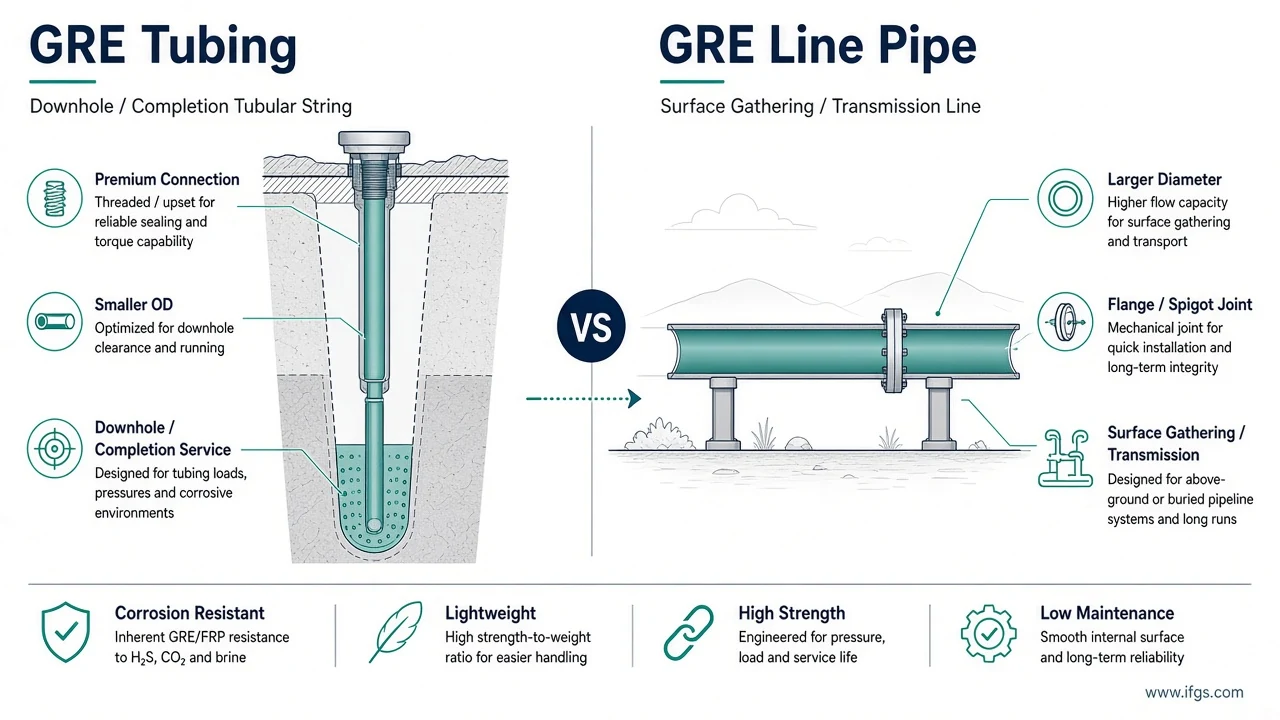
What buyers mean by GRE tubing
On IFGS pages, GRE tubing is the path for project-specific well or completion-adjacent glass-reinforced epoxy strings. Typical RFQ inputs include well duty and arrangement, fluid and temperature, internal/external pressure, axial or combined loads, and connection drawings — not a catalogue “one size” rating.
Browse the tubing category when the isometric or completion sketch is tubular. If the tender only says “GRE pipe,” ask engineering whether the string is downhole/tubular versus surface line before you shortlist SKUs.
What buyers mean by GRE pipe (line pipe)
GRE pipe in procurement usually means rigid surface line pipe: gathering, produced-water, injection, or utility transfer on the pad or corridor. Selection still needs fluid, design pressure and temperature, diameter, resin system, and joint family (bell-and-spigot, coupler, thread, bonded) so bids are comparable.
Start in the line pipe category. Joint hardware follows the pipe family — do not paste a spoolable RTP end-fitting list into a rigid GRE line-pipe RFQ.
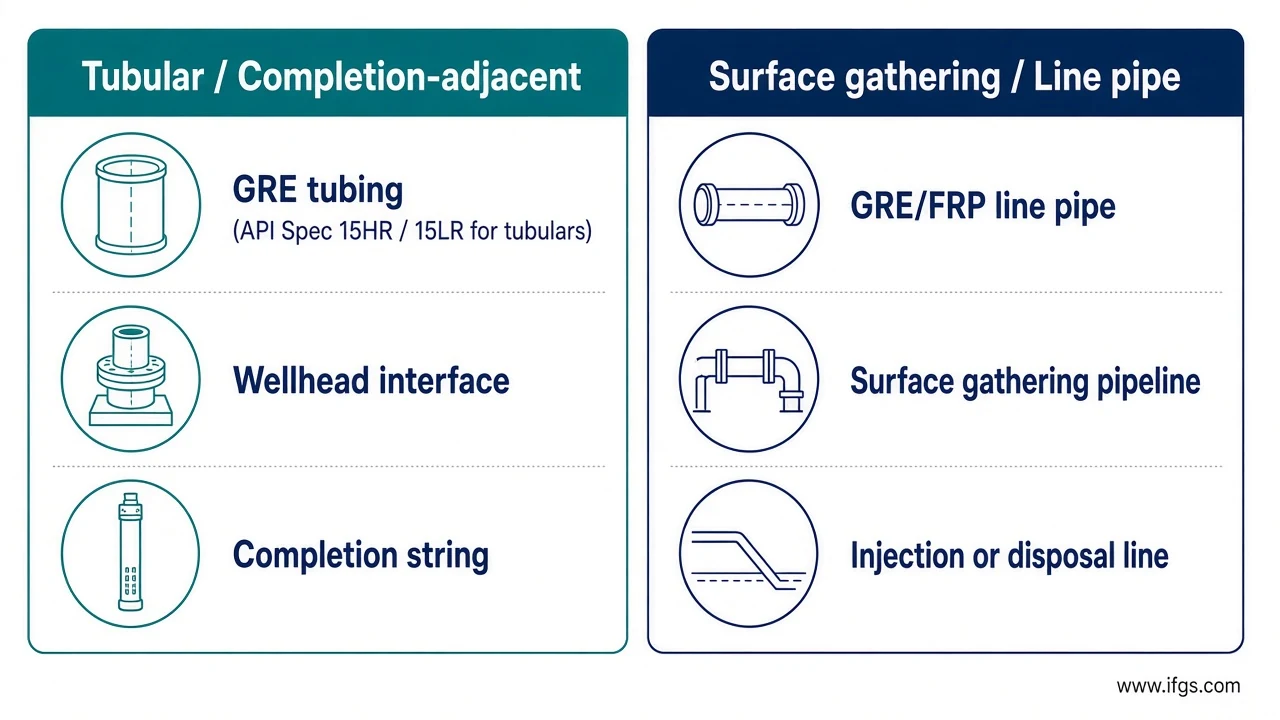
Comparison table: tubing vs line pipe vs (not) 15S RTP
| Buyer question | GRE tubing (tubular) | GRE / FRP line pipe | Not this: RTP (15S) |
|---|---|---|---|
| Where it usually sits | Well / completion-adjacent tubular string | Surface gathering, injection, transfer | Spoolable continuous lengths on reels |
| Common standards language | API Spec 15HR / 15LR (letters matter) | Often 15HR / 15LR for GRE/FRP stick pipe | API Spec 15S only — never write 15HR/15LR on the same line item |
| IFGS entry pages | GRE tubing · tubing category | line pipe category | Separate RTP product RFQ (out of scope here) |
| What the RFQ must name | Well duty, loads, connections, P/T, fluid | Service, burial/surface, joint family, P/T, OD | Reel plan, end fittings, 15S language |
| Common mix-up | Buyer says “GRE pipe” but means tubing | Buyer says “GRE tubing” but means surface line | Buyer pastes “API 15” with no letter |
Spec tip: If the tender only says “API 15” with no letter, stop and clarify. Mixing 15S with 15HR / 15LR is a scope error, not a branding preference. IFGS will not invent listing marks or logos in a quote pack.
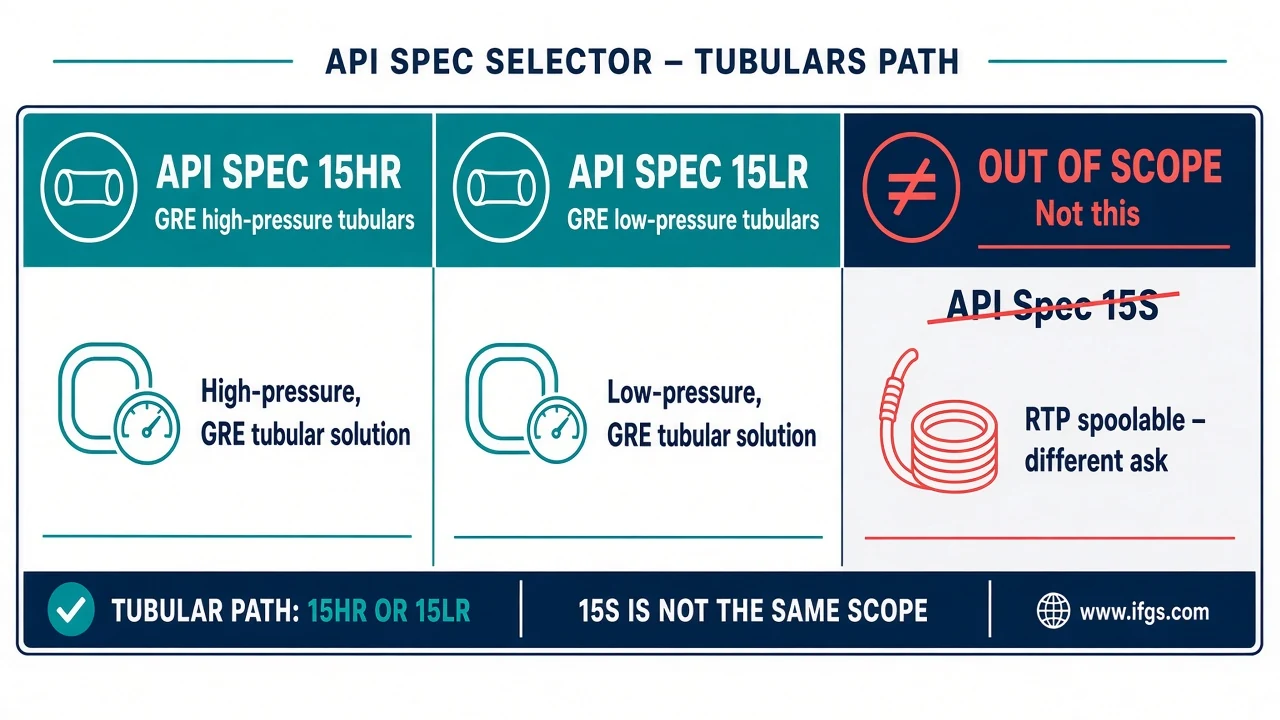
When to ask for tubing vs line pipe
- Ask for GRE tubing when the sketch is well duty, completion arrangement, pump-compressor or water-injection tubular, and connections/loads matter as much as diameter.
- Ask for GRE / FRP line pipe when the sketch is surface corridor, gathering, or pad transfer and joint family + burial assumptions drive the BOM.
- Open a separate RTP RFQ when the need is spoolable reels under API Spec 15S — do not merge it into this terminology page’s line items.
RFQ field checklist (make bids comparable)
- Family name — GRE tubing (tubular) or GRE/FRP line pipe (surface). Avoid “GRE pipe or equal” without geometry.
- Standards letter — API Spec 15HR or 15LR when that is your tender frame; state explicitly if anything is RTP / 15S.
- Duty — well arrangement vs surface service; burial or aboveground.
- Fluid and temperature — chemistry, operating and design temperatures, units; note H₂S / CO₂ / salinity if known.
- Pressure — internal/external or design pressure as project fields (not invented acceptance numbers).
- Dimensions and connections — OD/DN or size class; thread or joint drawing; seals and interfaces.
- Loads — axial / combined loads for tubular strings; thrust / restraint notes for joints on line pipe.
- Quantity, destination, documents — ITP / datasheet expectations; no fake monogram language.
Honest IFGS angle (Dongying)
IFGS is a Dongying manufacturer of GRE / FRP / RTP oilfield equipment. Use this terminology page to stop mixed labels before you compare plants — including us. We will not claim a USA factory, invent monograms, or treat 15S RTP as interchangeable with 15HR/15LR tubular or line pipe.
Related on this site: Products hub, GRE tubing, tubing, line pipe, and Contact us for datasheets and configuration review.
Next step
GRE tubing product
· Tubing category
· Line pipe category
· Contact us / request documents
FAQ
Is GRE tubing the same as GRE pipe?
Not in procurement. Tubing usually means well or completion-adjacent tubular strings; GRE pipe usually means rigid surface line pipe. Same material class can appear in both, but RFQ fields and joint/connection scope differ.
Do API 15HR and 15LR apply to RTP?
No. Spoolable RTP buyer language usually sits with API Spec 15S. Keep 15HR/15LR on GRE/FRP tubular or stick line-pipe conversations; open a separate RFQ for RTP.
Does IFGS have a USA factory?
No. Dongying, China only on this page.