A spigot joint on fiberglass / GRE line pipe is the male pipe end seated in a matching bell. Buyers use this guide to separate bell-and-spigot from double-bell coupler kits and build a comparable RFQ.
IFGS manufactures GRE / FRP pipe systems and joint kits in Dongying, China. We do not claim a USA factory. Product envelopes below follow published IFGS catalog lines; request size-specific drawings and datasheets before you freeze a bid tab.
Browse the full catalog at IFGS products, then open the Joints & Couplers collection when the string design depends on the coupler kit as much as the pipe wall.
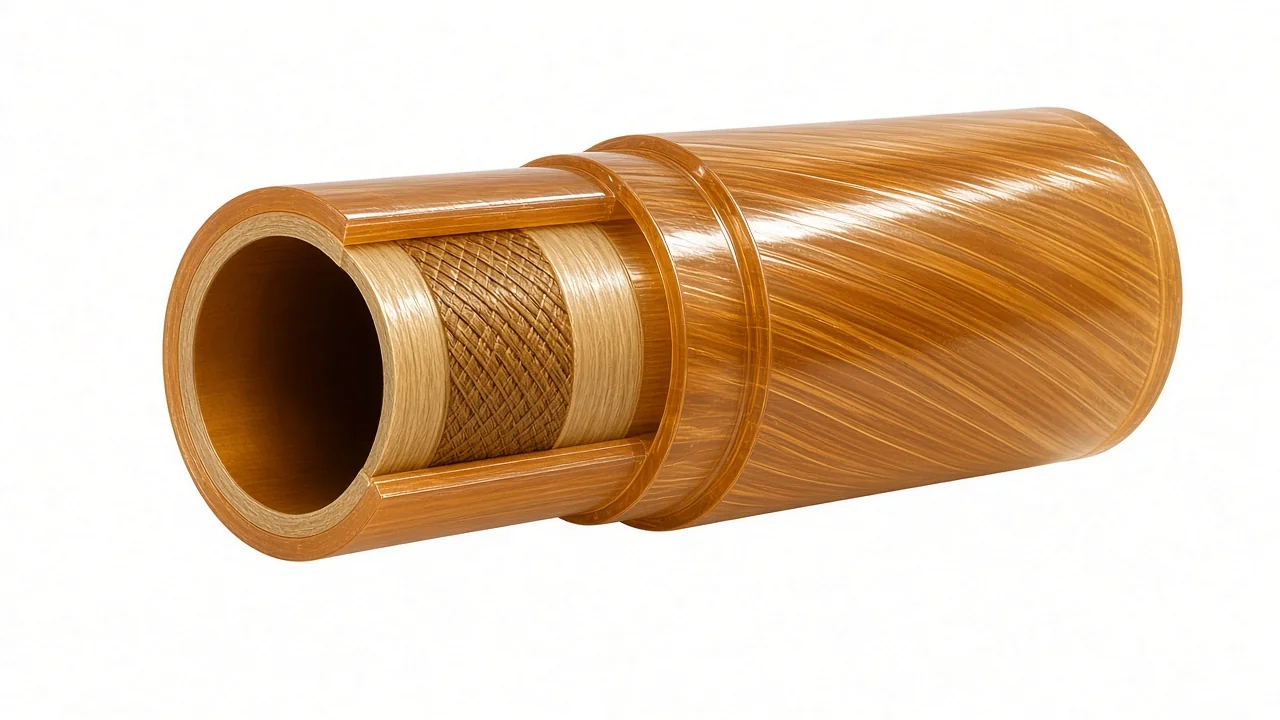
What a spigot joint means on fiberglass / GRE pipe
In GRE / FRP line-pipe language, a spigot is the male pipe end machined or formed to enter a matching bell (female) socket. A spigot joint — often called a fiberglass spigot joint or bell-and-spigot joint — is the assembled connection: spigot + bell + sealing system (and, when specified, a locking / restraint feature).
On IFGS pages, the common rubber-seal path is the Rubber-Seal Bell & Spigot Joint: the spigot seats in a belled end with an elastomeric seal. Published catalog envelope: up to 1,400 mm and up to 50 bar. That family is listed as a non-restrained joint with flexibility and deflection — it requires thrust blocks or hybrid systems unless you switch to the locked sister product.
When buyers say “GRE pipe joint” without naming the family, vendors cannot price the same scope. Spigot / bell-and-spigot, double-bell coupler, adhesive-bonded (cemented), and threaded joints are different kits with different civil and install assumptions.
Spigot (bell-and-spigot) vs double-bell coupler
These two names are the most common mix-up in composite buried-line RFQs.
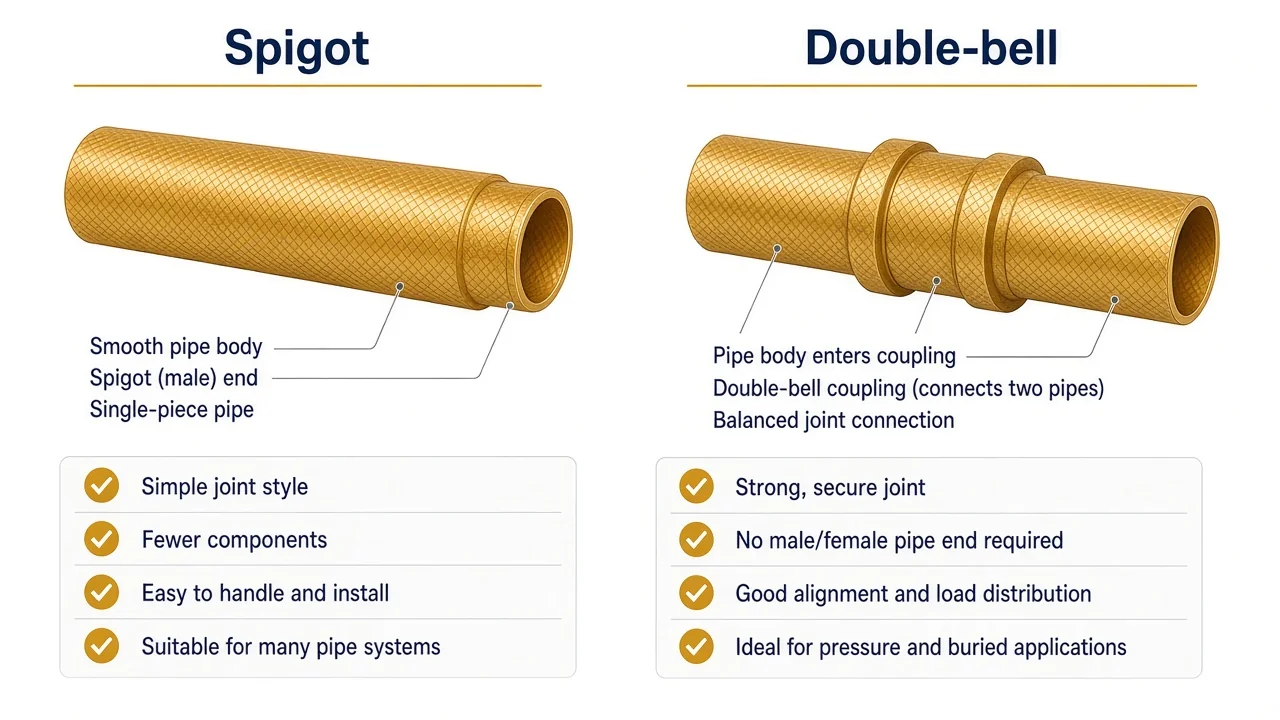
| Buyer question | Rubber-seal bell & spigot | Double-bell coupler |
|---|---|---|
| What enters what? | Pipe spigot enters a belled pipe end (integral or formed bell) | Two plain / spigot-style pipe ends enter a separate double-bell coupling sleeve |
| IFGS product page | Rubber-seal bell & spigot | Double Bell Coupler Joint |
| Published size / pressure headline | Up to 1,400 mm; up to 50 bar | Up to 4,000 mm; up to 40 bar |
| Restraint (catalog) | Non-restrained (locked sister available) | Non-restrained; high flexibility / deflection |
| Thrust management | Thrust blocks or hybrid systems (non-restrained) | Thrust blocks or hybrid systems |
| Typical install note | Usually buried; hydropower may use aboveground | Usually buried; hydropower may use aboveground; testable joint configuration available |
Spec tip: Do not write “spigot joint or equal” if you actually need a separate coupler sleeve for large OD. A double-bell coupler is a distinct SKU and logistics item (coupler count, gasket set, spare kit). Conversely, if your isometric assumes integral bells on every stick, a double-bell BOM will not match the field.
Catalog headlines are not a combined rating claim (for example, do not assume 50 bar at 1,400 mm without the size-specific datasheet). Ask IFGS for the drawing that matches your diameter and pressure class.
Locked / restrained spigot option
If the civil package cannot carry thrust blocks, evaluate the Rubber-Seal Bell & Spigot Locked Joint. IFGS lists the same published size/pressure headline (up to 1,400 mm / up to 50 bar) but as a restrained joint that does not require thrust blocks, typically for buried service. Put “locked vs non-restrained” in the RFQ so civil and piping quotes stay aligned.
Other GRE / FRP joint families buyers compare
Spigot language often appears next to other IFGS joint pages. Short map for RFQ clarity:
- Adhesive bonded (cemented) joint — chemically bonded, restrained path; catalog lists up to 1,200 mm and up to 70 bar (not a claim of 70 bar at 1,200 mm combined). Request adhesive procedure, cure window, and inspection steps. See Adhesive Bonded (Cemented) Joint.
- Thread joints — restrained mechanical make-up; IFGS publishes thread joints with fiberglass or stainless-steel couplings (catalog headlines up to 26 in / up to 3,000 psi (200 bar), API 5B 8rd / 4rd language on those pages). Useful when aboveground or buried strings need restraint without thrust blocks. Start with thread joint with fiberglass coupling.
- Double-bell coupler — separate sleeve; large-diameter buried flexibility; see above.
Pick the joint family first; then match resin system, diameter, and design pressure/temperature to the pipe family on products.
Standards language: do not mix 15S with 15HR / 15LR
Joint hardware follows the pipe family on the tender:
- API Spec 15HR / 15LR — GRE fiberglass tubular / line-pipe conversations (letters matter).
- API Spec 15S — spoolable RTP / reinforced thermoplastic systems — different product family, different end fittings. Do not paste a 15S coupler list into a rigid GRE spigot RFQ, or vice versa.
If the tender only says “API 15” with no letter, stop and clarify before you ask for joint datasheets. Mixing 15S with 15HR/15LR is a scope error, not a branding preference. IFGS will not invent listing marks or logos in a quote pack.
When buyers lean spigot vs double-bell vs thread / bonded
| Project signal | Often lean toward |
|---|---|
| Buried water / industrial / hydropower-adjacent GRE/FRP; want push-fit style seal; OD within ~1,400 mm catalog path | Rubber-seal bell & spigot (locked if no thrust blocks) |
| Very large OD; need a separate coupler sleeve; buried flexibility; interest in testable joint option | Double-bell coupler |
| Need restrained make-up without thrust blocks; aboveground or mixed; thread preference on the isometric | Thread joint (fiberglass or SS coupling as specified) |
| Bonded / laminated construction procedure already in the project spec | Adhesive bonded (cemented) joint — confirm adhesive kit and cure plan |
| Spoolable continuous lengths / reeling | RTP (15S) end fittings — not this spigot guide |
These are selection heuristics for RFQ clarity, not a substitute for project engineering. Temperature, fluid chemistry (including H₂S / CO₂ / aromatics when known), burial load, and deflection limits belong in the brief.
RFQ checklist for fiberglass spigot / GRE pipe joints
Send the same fields to every bidder so joint kits are comparable:
- Joint family name — rubber-seal bell & spigot (non-restrained or locked), double-bell coupler, adhesive bonded, or thread joint. Avoid “spigot or equal” without geometry.
- Pipe family — GRE / FRP line pipe (and whether the tender cites API Spec 15HR or 15LR). State explicitly if anything is RTP / 15S.
- Diameter and pressure class — OD/DN and design pressure; flag if you sit near published catalog ceilings.
- Design temperature and fluid — oil, produced water, injection, chemical, multiphase; list known corrosives.
- Restraint / thrust plan — thrust blocks, hybrid systems, or “prefer restrained / locked / threaded — no thrust blocks.”
- Install mode — buried vs aboveground; hydropower or special deflection notes; alignment and support assumptions.
- Seal / elastomer and spare kit — gasket material preference if specified; quantity of spare seals/couplers.
- Test expectations — joint hydrotest, testable coupler configuration (double-bell), witness points, third-party inspection.
- Quantity and logistics — meterage, stick lengths, coupler count, fittings list, destination, delivery window.
- Documents to request by name — joint datasheet, installation procedure, ITP outline, material certificates for the construction offered — not only a unit price.
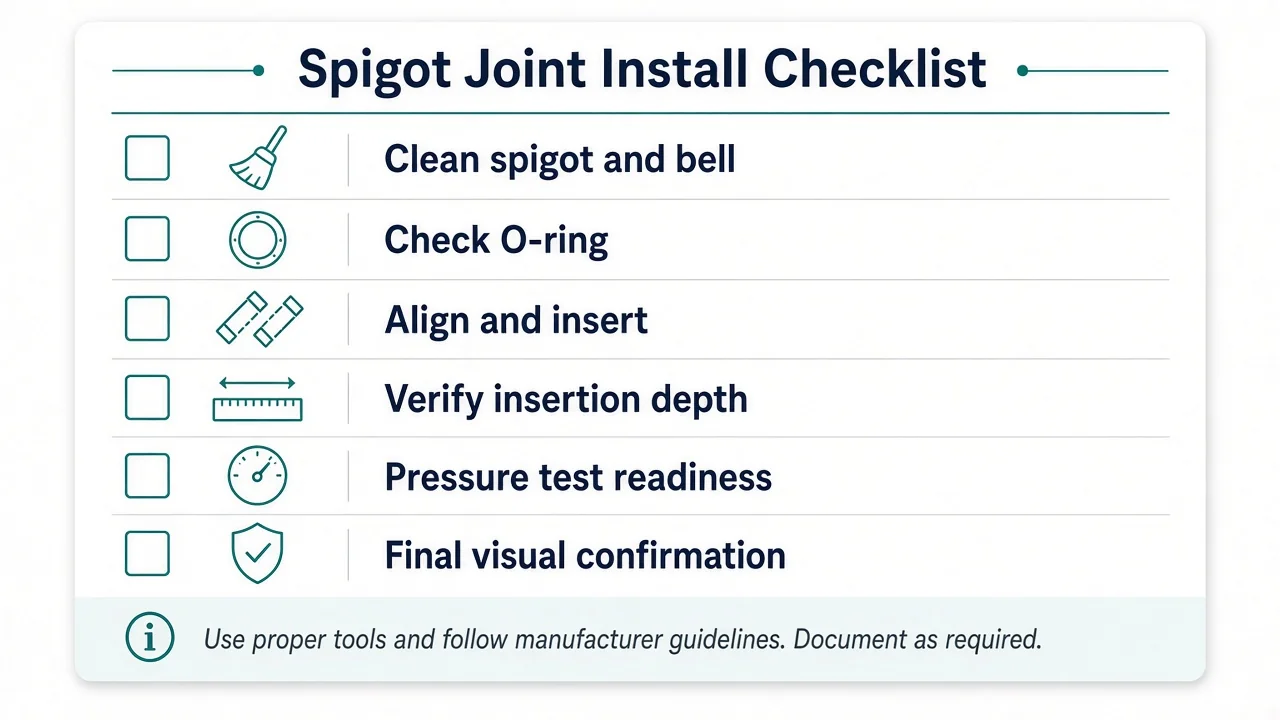
Field install notes buyers should put in the bid package
Even a correct joint SKU fails if the install procedure is missing from the RFQ. Ask vendors to confirm:
- End protection during shipping and trench handling (spigot edges and seal grooves are damage-sensitive).
- Cleaning and lubrication of seal surfaces per the joint procedure (product-specific — do not improvise from steel gasket practice).
- Allowed angular deflection and pull / push forces for make-up.
- When the line may be pressurized relative to cure or lock engagement (especially adhesive-bonded paths).
- Thrust-block or anchor locations if the joint is non-restrained.
- Hydrotest boundaries: factory vs field; joint inclusion in the test section.
Unequal bids often hide missing joint scope (couplers, seals, adhesive kits, thrust civil) rather than a cheaper pipe meterage.
What IFGS will and will not claim
IFGS is a Dongying manufacturer of GRE / FRP / RTP oilfield equipment. This article does not invent API logos, fake certificates, or named competitor brands. Catalog envelopes are starting points for RFQs; verified ratings are document-driven for your diameter and service.
For product selection, use Browse all IFGS products and the joint pages linked above. For a quote pack, use Contact us with the RFQ checklist completed as far as you can.
FAQ
Is a spigot joint the same as a double-bell coupler?
No. A spigot / bell-and-spigot connection seats a male end in a bell. A double-bell coupler is a separate sleeve that accepts pipe ends from both sides. Spec the geometry you drew on the isometric.
Do non-restrained spigot and double-bell joints need thrust blocks?
Yes on IFGS non-restrained catalog language: thrust blocks or hybrid systems. Use locked spigot, adhesive bonded, or thread paths when the project prefers restraint without those civil works — confirm on the product datasheet.
Can I use this guide for API 15S RTP?
No. Spoolable RTP systems use API Spec 15S language and different end fittings. This page is for rigid GRE / FRP jointed strings (often discussed with 15HR / 15LR when those letters appear on the tender).
What should I send IFGS for a first joint quote?
Joint family, DN/OD, design P/T, fluid, buried vs aboveground, restrained vs non-restrained preference, quantity/coupler count, and an explicit datasheet request. Start at contact-us.
Next step
Lock the joint family name (spigot / double-bell / thread / bonded), fill the RFQ checklist, and request a technical review from IFGS. Product hub: View the IFGS product catalogue · Joints collection: Joints & Couplers.