Cemented Joint for Fiberglass Pipe: What Buyers Spec Before RFQ
A cemented joint is an adhesive-bonded connection on GRE/FRP stick pipe: prepared ends, often with a sleeve or tapered bell, are bonded with a controlled adhesive kit and cured — chosen when bond-line make-up fits better than a wrap or a mechanical coupler.
IFGS sources GRE / FRP oilfield pipe and joint kits from licensed partner factories in China and worldwide and handles spec confirmation, procurement and pre-shipment QC. IFGS has no factory of its own; it connects buyers to licensed partner factories in China and worldwide. This page is a buyer RFQ / selection guide for adhesive-bonded joints on stick line pipe. It does not redo the lamination joint buyers guide, the spigot joint buyers guide, the fiberglass coupling types blog, or the live double-bell coupler RFQ. No fake certificate or monogram claims here.
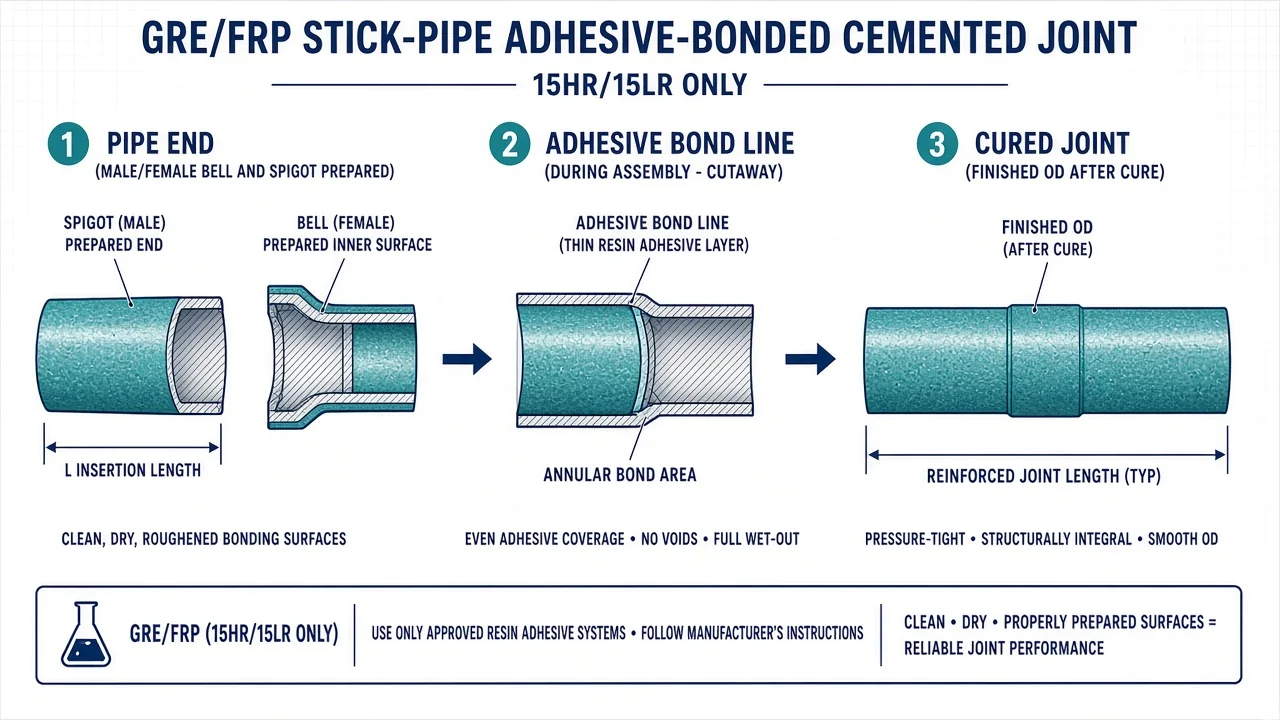
What a cemented joint is on a GRE / FRP RFQ
On bid forms, buyers write cemented joint, adhesive bonded joint, GRE cemented joint, FRP adhesive joint, or bonded joint fiberglass when they mean an adhesive-bonded connection: prepare the mating surfaces, apply a specified adhesive (often called pipe cement) within pot life, assemble the ends — typically a tapered bell and spigot or a bonding sleeve — and hold alignment until the bond line cures. The seal and much of the axial restraint come from that cured adhesive film, not from a glass wrap and not from a push-on or threaded seal alone.
Product entry for this path: Adhesive Bonded (Cemented) Joint. Treat website adjectives as marketing until the quote pack names construction, adhesive system, cure procedure, and the documents you will buy.
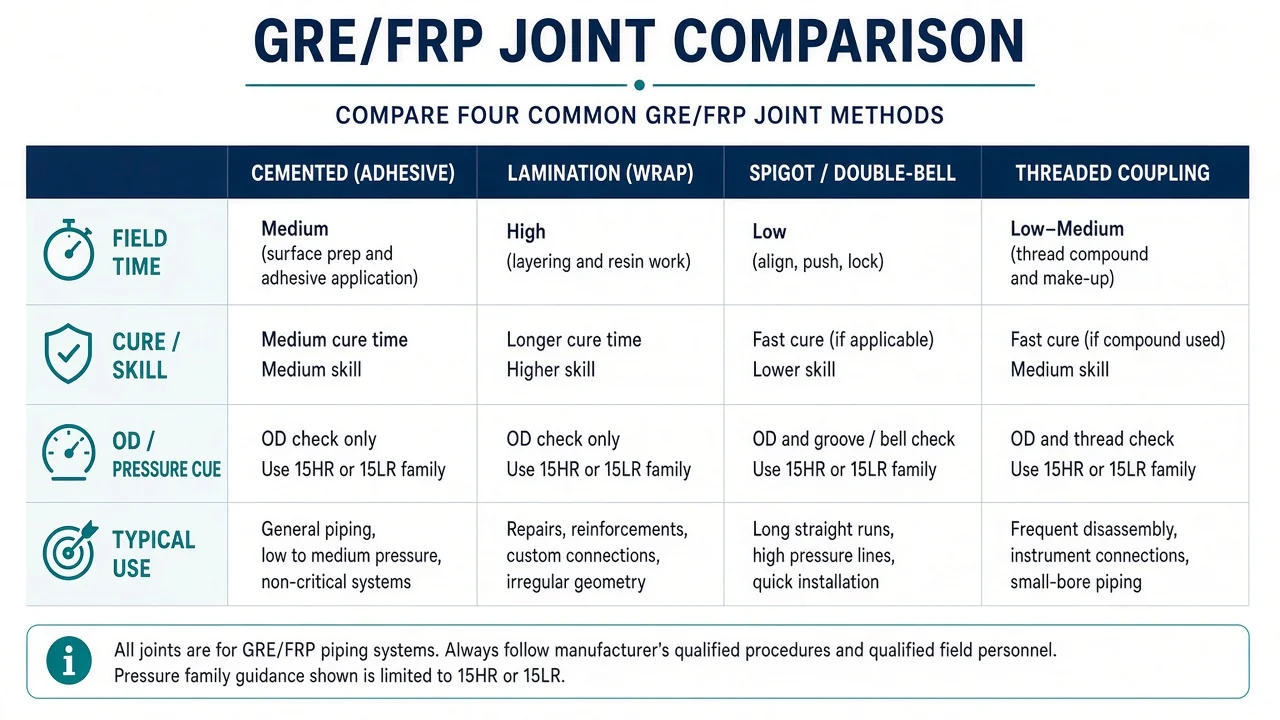
Cemented vs lamination vs mechanical joints
Do not freeze “fiberglass joint or equal.” Lock the joint family first:
- Cemented (adhesive-bonded) — adhesive bonds prepared pipe ends, often inside a sleeve or tapered socket. Pot life, surface prep, alignment, and cure control dominate. This page is that family.
- Lamination (wrap / butt-and-wrap) — glass and resin layers built over the joint zone until the OD blends. Layup skill and wrap cure drive quality; restraint comes from the laminate. See the lamination joint buyers guide and the Lamination Joint product page. A heavier wrap class is listed as Super Lamination Joint — confirm that configuration on a drawing; do not treat the name as a rating.
- Mechanical — spigot / bell-and-spigot, double-bell coupler, or threaded coupling make-up. Install speed and seal geometry matter more than adhesive cure. Use the spigot joint buyers guide for spigot and double-bell geometry, and the fiberglass coupling types (GRE/FRP) blog for threaded vs mechanical sleeves. This page does not restate those RFQs.
When buyers choose a cemented joint
How IFGS works on this order — we do not invent combined OD × pressure ratings, cure clocks, or adhesive grades on this page. Buyers typically open a cemented path when:
- OD range — stick GRE or FRP sizes where a sleeve or tapered adhesive bond matches the isometric better than a long wrap or a thread make-up. State OD / ID or DN on the RFQ; confirm the size class on the drawing. There is no single cutoff published here.
- Pressure / temperature band — design, operating, and test numbers are project fields. Adhesive chemistry and pipe construction must match fluid and temperature. Ask for the joint datasheet for the configuration offered — do not copy a catalog adjective into the spec as a rating.
- Shop vs field — shop bonding when pot life, alignment jigs, and cure temperature are easier to hold; field bonding for tie-ins where the crew can still control prep, fit-up, and ambient through the cure window. If that control is weak, compare lamination or mechanical families before you award on kit price alone.
- Cure time — adhesive- and temperature-dependent. Specify the minimum cure before handling, backfill, or pressure test. Do not assume one clock fits every resin system or every desert / winter ambient.
- Surface prep — clean, dry, abraded bond surfaces per the procedure; assemble inside pot life; keep the bond line free of oil, dust, and moisture. Contamination and an expired mix are the usual reject causes, not “more adhesive.”
Spec language: stick GRE 15HR/15LR — not 15S
Keep tender language clean. Stick GRE line pipe often sits with API Spec 15HR (high pressure) or 15LR (low pressure). Spoolable RTP under API Spec 15S uses different end fittings and reel construction — do not mix 15S fittings into this cemented stick-joint guide. This page is not the 15HR-versus-15LR explainer; name the spec your tender already uses and ask the quote to match it. Family selector context: non-metallic pipe GRE / FRP / RTP. Plant qualification: fiberglass pipe manufacturers buyer checklist.
RFQ field checklist
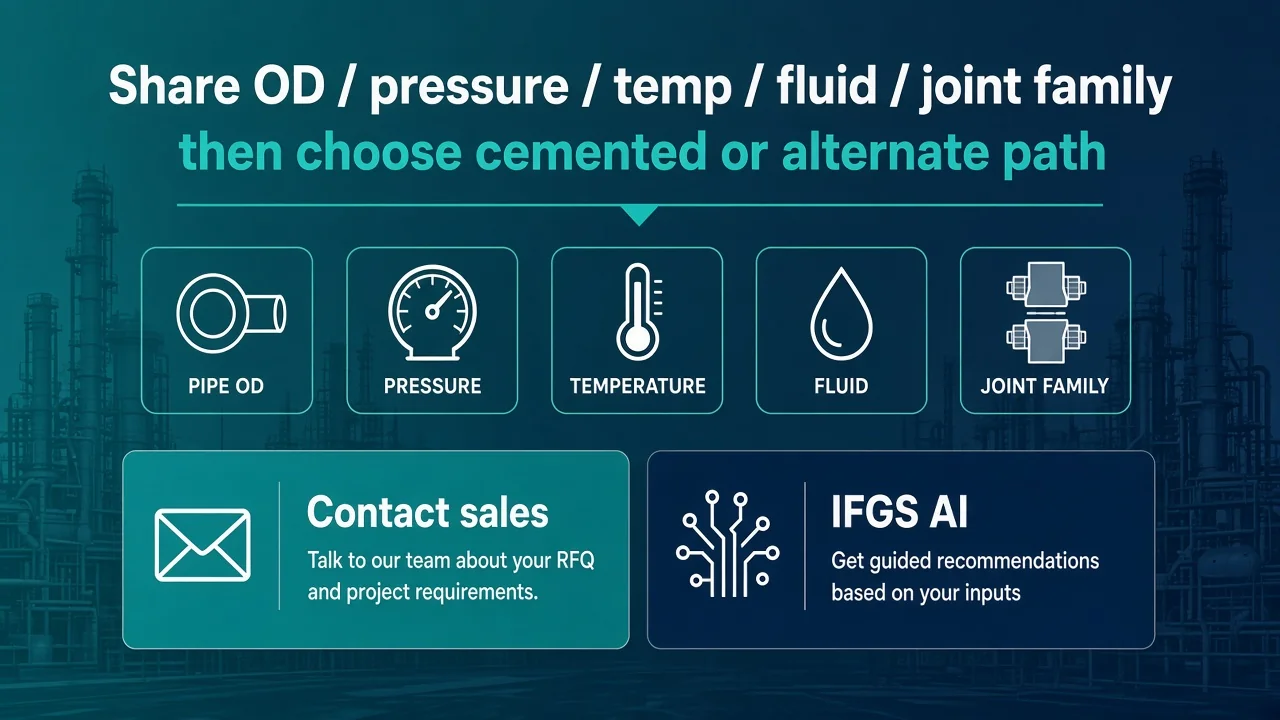
- Joint family — cemented (adhesive-bonded), lamination (standard or super), or mechanical (spigot / double-bell / threaded). Avoid bare “FRP joint.”
- Standards frame — API Spec 15HR / 15LR for stick GRE when that is your tender language. Do not paste 15S reel fittings here.
- OD / ID or DN and design / operating / test pressure as project fields.
- Temperature — continuous and upset; note ambient for field cure and adhesive pot life.
- Fluid / medium and corrosives (H₂S / CO₂ / chlorides / aromatics if known).
- Install envelope — shop bond vs field bond; buried / aboveground; access for abrasion, assembly, and cure.
- Adhesive procedure — kit type, surface-prep steps, pot life, cure window before test, NDE / witness points, repair criteria.
- Mating parts — pipe body construction, bonding sleeves or tapered ends, fittings, flanges, and any transition to a laminate or mechanical family on the same string.
- QA documents — joint datasheet, ITP outline, install procedure, material / traceability as required. No stand-in certificates on this page.
- Quantity and logistics — joint count, spare adhesive kits / consumables, destination, delivery window.
If joint family or cure envelope is blank, quotes will diverge on labor and rework risk before unit price does.
How IFGS works on this order
IFGS is a sourcing and QC partner for GRE / FRP / RTP oilfield equipment: it connects buyers to licensed partner factories in China and worldwide and handles spec confirmation, procurement and pre-shipment QC. Use this page to lock the adhesive-bonded joint path; use product drawings and the manufacturer checklist to lock the plant and the documents. IFGS has no factory of its own and will not invent certificates. Browse families: IFGS products.
Next step
Contact us / request documents
· IFGS AI
· Adhesive Bonded (Cemented) Joint
· Products
FAQ
What is a cemented joint on fiberglass pipe?
A cemented joint joins GRE/FRP stick pipe with a controlled adhesive bond — often a tapered bell and spigot or a bonding sleeve — after surface prep and cure. It is not a wrap lamination and not a mechanical spigot, double-bell, or threaded coupling.
When should I choose cemented instead of lamination or mechanical?
Choose cemented when an adhesive kit, bond-line prep, and a defined cure window fit the isometric better than a glass wrap or a push-fit / threaded coupler. If the crew cannot hold prep, pot life, and ambient, compare lamination or mechanical families before award.
Does this guide cover API 15S RTP end fittings?
No. Stick GRE often uses 15HR / 15LR; spoolable RTP uses 15S with different end fittings. Do not mix families on one RFQ line.
Does IFGS have its own factory?
No. Shipped from the licensed partner factory selected for your order.