Fiberglass Well Casing: What Buyers Spec Before RFQ
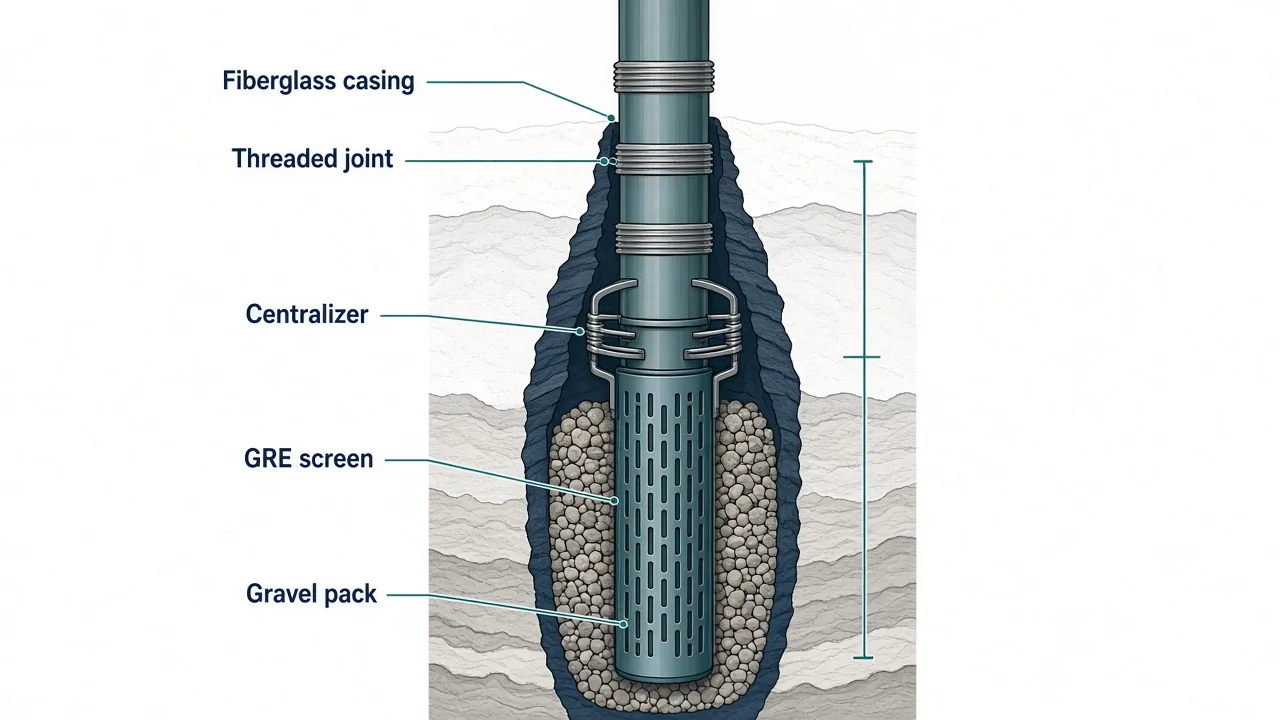
Fiberglass well casing is downhole GRE/FRP pipe wound from epoxy resin and high-strength glass roving. It lines the wellbore. It is not a slotted screen and not production tubing, and size, loads, and connections stay project fields.
IFGS sources GRE / FRP oilfield tubulars from licensed partner factories in China and worldwide and handles spec confirmation, procurement and pre-shipment QC. IFGS has no factory of its own; it connects buyers to licensed partner factories in China and worldwide. This buyer RFQ covers fiberglass casing, including searches for fiberglass casings, FRP well casing, GRE casing, and fiber casing. It does not rewrite the 950 m inquiry example (2022), the screen-tube sand-control RFQ, the CBM screen explainer, the Mongolia 2023 CBM case, the 15HR / 15LR tubing RFQ, or GRE tubing vs GRE pipe. No API monogram or UL mark is claimed.
What the fiberglass casing page actually publishes
Open Fiberglass Casing. The page says downhole GRE casing is made by micro-controlled filament winding of epoxy resin and high-strength glass fiber roving. Send well depth, dimensions, fluid conditions, external loads, and connection details so design and documents can be confirmed.
- Diameter: DN100–DN250. The page also says product can be designed to customer demands and is not limited to those sizes.
- Pressure grating: 10 MPa–25 MPa. The page calls this general information — design parameters based on special materials and technical status — and says it cannot be used as an inspection basis. Separate range limits are not a combined rating.
- Applications named: casing-damage well repair, water-source wells, CBM straight wells, and other duties per customer design.
- Characteristics named: corrosion resistance, long service life, light weight and low job costs. Not a year-count, collapse figure, or cost model.
No collapse pressure, tensile rating, or maximum setting depth is published. Request the datasheet for the configuration offered. The products index asks you to confirm hole size and cement plan in the RFQ. Those are fields, not ratings.
Casing vs screen vs tubing
Freeze the family. Buyers mix these three:
- Casing — plain string that lines the well. This page.
- Screen — wound GRE, then bored or slotted. You supply slot or hole size, pattern, and open area. Paths: GRE Screens & Pipes, GRE Screen Tube, GRE Screen Tubing. Checklist: sand-control RFQ. No slot chart is invented here.
- Tubing — completion-adjacent tubular, not casing and not surface line pipe. See GRE tubing vs GRE pipe and the 15HR / 15LR tubing RFQ.
Fiberglass casing and screen means plain casing plus a screen section on one schedule. The 950 m post is a 2022 inquiry example only; that page says the figures are not an approved rating or a completed job. CBM screen reading stays on the explainer and the Mongolia 2023 case.
Geothermal and monitoring wells are not on the casing application list. Mark them as other duties and send well data. The geothermal fiberglass pipe note is background, not a casing datasheet.
Fiberglass vs steel vs PVC
Qualitative only. No extra collapse, depth, or pressure numbers beyond the catalog ranges above.
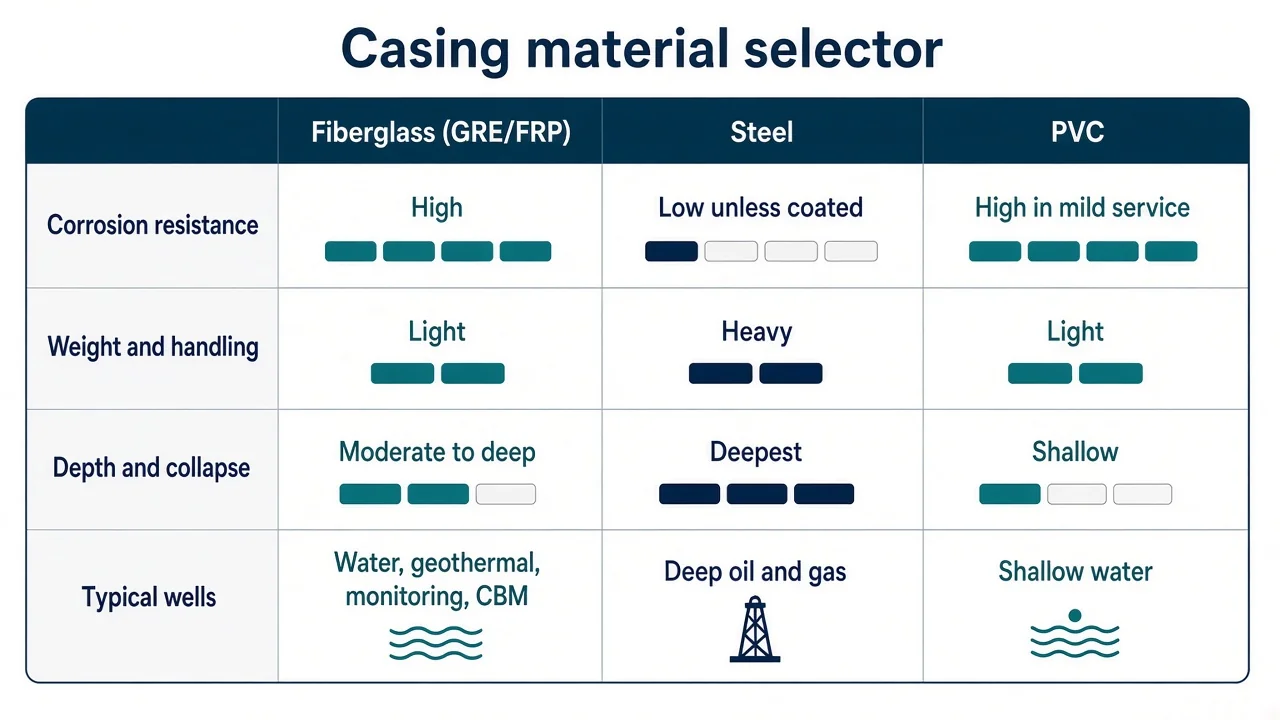
- Corrosion. The page lists corrosion resistance. GRE casing is the shortlist when saline or other corrosive water, or a casing-damage repair, is the reason to leave a steel corrosion allowance. Steel can still win on mechanics. “Long service life” is not a year-count.
- Weight and handling. The page lists light weight and low job costs — a handling cue versus steel, not a kilogram table or a savings sheet. PVC is light too, and it is a different material and joint, not a synonym for GRE casing.
- Depth and collapse. You send external pressure and hanging tension. No collapse rating or maximum setting depth is published. Steel is the usual benchmark when those loads dominate. PVC is a milder, shallower water-well conversation, not the same structural class. Do not infer a depth limit from DN100–DN250 or from 10–25 MPa.
Standards the casing page names — and what it does not
The casing page references two titles:
- API 15HR — Specification for High Pressure Fiberglass Line Pipe (page text: “API 15 HR”).
- SY/T 6267-2006 — Specification for High Pressure Fiberglass Line Pipe.
A title on the page is not an API monogram and not a UL mark. None is shown. Ask the quote for the edition, the tests, and the documents you will buy. See the fiberglass pipe manufacturers buyer checklist.
Never call this casing API 15S. 15S is spoolable RTP, not a casing joint. API 15LR is not named on the casing page; it belongs on tubing and stick-pipe tenders. A bare “API 15” with no letter is a split-the-line error.
RFQ field checklist
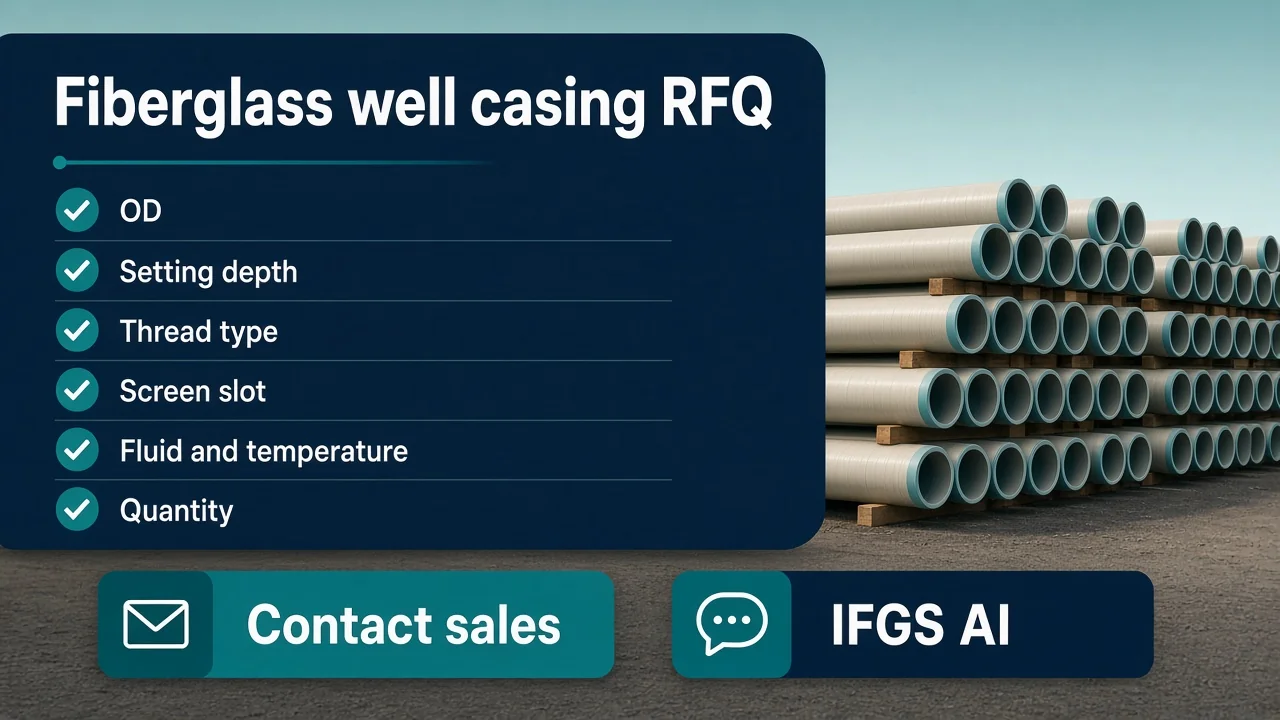
- OD / ID — with units. Catalog note DN100–DN250; flag custom outside it.
- Wall or pressure class — your field. The 10–25 MPa grating is not a combined rating and not an inspection basis.
- Collapse and tensile need — external loads and axial tension. Not one catalog number.
- Setting depth and a short profile. No maximum depth is printed.
- Thread / joint type — drawing or description. The page freezes no thread form.
- String length — joint length and total meters or count.
- Screen slot, if paired — size, pattern, open area, or “TBD.” Say “plain casing” if there is no screen.
- Fluid and temperature — chemistry, salinity, operating temperature.
- Quantity, including spares.
- Destination and delivery window. Supply: the licensed partner factory selected for your order.
Name the duty (casing-damage repair, water-source well, CBM straight well, or other) and hole size or cement plan if you have them. Ask for the casing datasheet, connection information, and qualification documents. Blank diameter, loads, or connection means the quotes will not match.
How IFGS works on this order
IFGS is a sourcing and QC partner: it connects buyers to licensed partner factories in China and worldwide and handles spec confirmation, procurement and pre-shipment QC. Lock the casing RFQ here; lock the plant and documents on the drawing and the manufacturer checklist. IFGS has no factory of its own, holds no API Monogram, and quotes no collapse rating the catalog does not print. Browse IFGS products.
Next step
Contact us / request documents
· IFGS AI
· Fiberglass Casing
· Products
FAQ
What is fiberglass well casing?
Filament-wound GRE/FRP pipe — epoxy and high-strength glass roving — that lines a well. Not a slotted screen and not production tubing.
What diameter and pressure does the catalog list?
DN100–DN250 and a pressure grating of 10 MPa–25 MPa, as general notes only. Not a combined rating and not an inspection basis. Other sizes can be designed. Ask for the offered configuration’s datasheet.
Is fiberglass casing API 15S?
No. The page references API 15HR and SY/T 6267-2006. 15S is spoolable RTP. 15LR is not named on the casing page.
Does IFGS have its own factory?
No. Shipped from the licensed partner factory selected for your order.