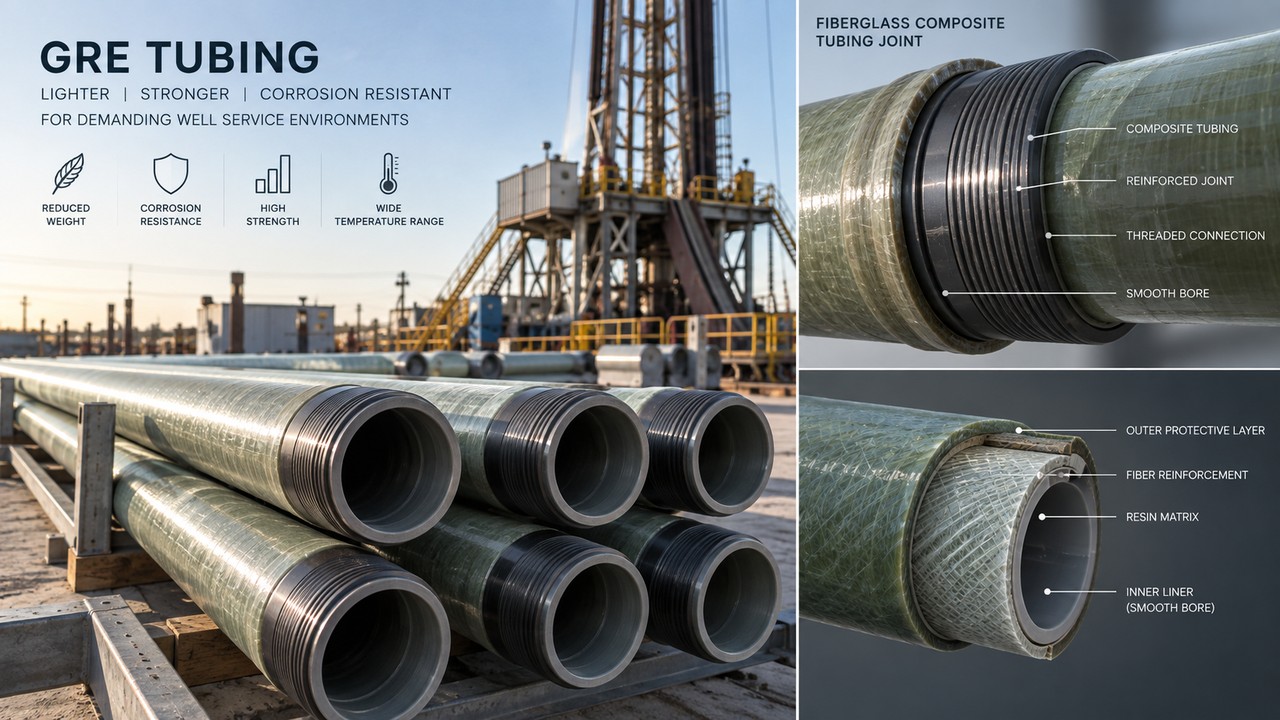
When your RFQ names GRE tubing, you are choosing a glass-reinforced epoxy string for oilfield or related downhole and utility duty—not a glossary entry. On injection, reinjection, and corrosive hydrocarbon service where steel fails early, that choice steers size, pressure class, API 15HR vs 15LR path, and which datasheet you ask IFGS to return from Dongying. This page walks you through what you should lock into your inquiry so your quote matches how IFGS builds GRE tubing.
What GRE tubing means on your oilfield RFQ
On IFGS product pages, GRE tubing is glass-reinforced epoxy tubing for oilfield and related downhole or utility duties where corrosion, weight, and reliability matter. The catalog also notes GRE piping for Marine & Offshore, Oil & Gas, and (Petro)chemical markets—including cooling and fire-fighting utilities. You should treat “GRE tubing” on a bid form as a product-family decision: name the duty, then name which API path your audit will follow.
Published catalog features you can reference include light weight, high-temperature and corrosion/erosion resistance, long life expectancy in hydrocarbon applications, and mechanical strength at high temperatures. You must treat specific size and pressure ratings for your string as confirmed on the datasheet for the duty you send—not as brochure inspection limits.
For your primary GRE tubing option, open GRE Tubing.
API 15HR vs API 15LR: which path your RFQ should name
Use this table when you shortlist the standards path before you ask for a datasheet or quotation:
| Decision factor on your project | API 15HR GRE Tubing path | API 15LR GRE Tubing path |
|---|---|---|
| What the designation means (IFGS) | API 15HR = High Pressure Fiberglass Line Pipe | API 15LR = Low Pressure Fiberglass Line Pipe |
| Catalog diameter / pressure (reference) | DN40–DN100; 10 MPa–25 MPa | Size/rating confirmed on the datasheet you request |
| Design-life myth to avoid | Standard designation — not a “15-hour” design life; state service life separately | Same rule: designation ≠ service life |
| Downhole caution | For injection / reinjection / polymer, specify well conditions; do not infer downhole suitability from a line-pipe number alone | Does not establish high-pressure drilling or downhole suitability; if your need is a well, say so and ask which product specification applies |
| Best when your scope… | Audits a high-pressure fiberglass line-pipe path and lists well/line duty clearly | Audits a low-pressure fiberglass line-pipe path and confirms surface vs well application |
When your RFQ will audit a high-pressure fiberglass line-pipe path, review API 15HR GRE Tubing.
When your RFQ will audit a low-pressure fiberglass line-pipe path, review API 15LR GRE Tubing.
You should treat catalogue diameter and pressure ranges as reference ranges only. Request the size-specific pressure-temperature rating and connection limits for your duty; a range does not prove every size at the upper pressure value.
RFQ checklist: what you should send so the quote matches your string
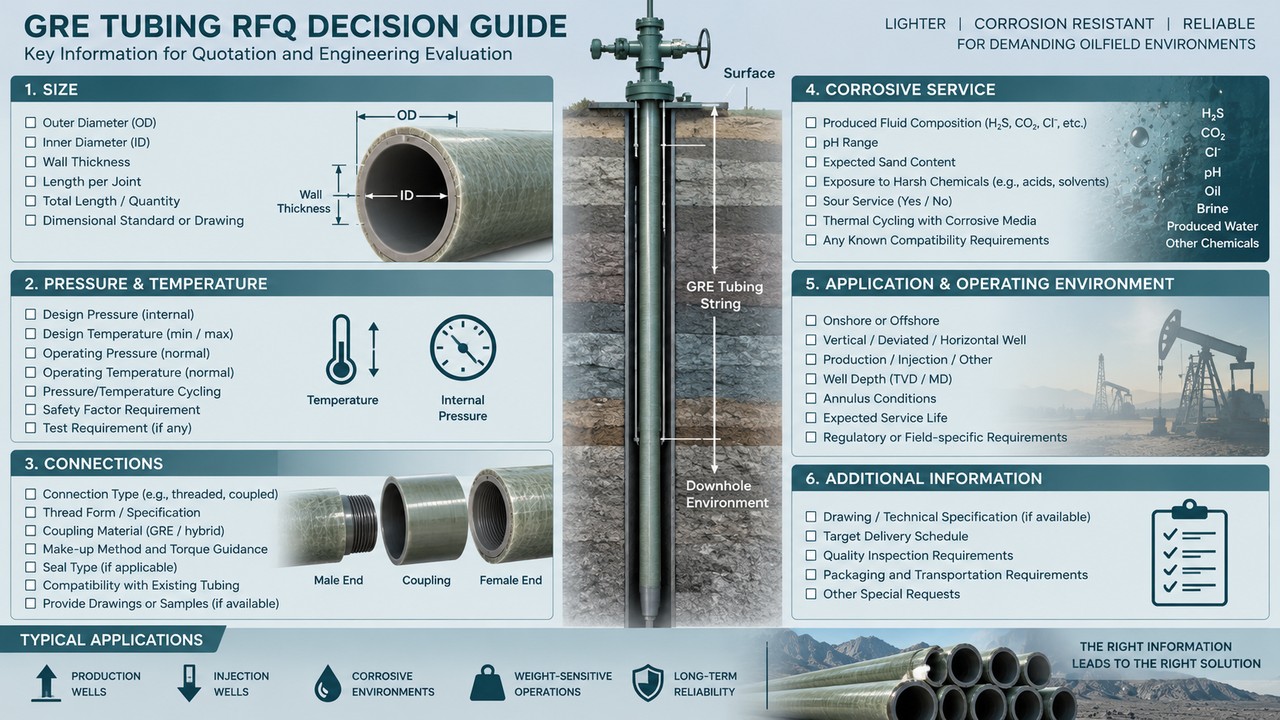
Before you request a quotation, put these items in your inquiry so IFGS can return verified technical data:
- 1. Duty and fluid — oil & gas, petrochemical, or marine utility context; name injection, reinjection, polymer, produced water, or other corrosive service.
- 2. Size and pressure class — flag if you need engineering review; stay honest about undecided fields.
- 3. API 15HR vs 15LR (or other) path — name which path your RFQ will audit.
- 4. Connection / joint preference if known — thread drawing, mating components, installed length, and mechanical loading.
- 5. Temperature and length/quantity schedule — normal and maximum temperature; operating and design pressure.
- 6. Delivery window and destination — enough for a real manufacturing quote from Dongying.
- 7. Ask for the GRE tubing datasheet by name — IFGS states a technical datasheet is not published on the product page; request verified dimensions, ratings, and supporting documents.
On the API 15HR sister page, IFGS also asks you for well depth and completion arrangement when the duty is downhole, plus inspection requirements, requested service life, and documentation for project approval. Put those in writing when they apply to your well.
Where GRE tubing fits on your oilfield line
IFGS manufactures GRE and FRP pipe systems in Dongying for oilfield and geothermal service where steel corrodes—produced water, injection, and chemical lines. You typically shortlist GRE tubing when you need a corrosion-resistant nonmetallic string and you are ready to name duty, size/pressure, and the API path your auditor will use. Decide 15HR vs 15LR with the table above before you freeze RFQ language.
Spec traps that slow your quote
You should watch for these gaps—they usually send a GRE tubing RFQ back with clarifying questions instead of numbers:
- You wrote “GRE tubing” but did not say API 15HR vs 15LR.
- You treated “15HR” as a 15-hour design life instead of High Pressure Fiberglass Line Pipe—and never stated the service life you need.
- You assumed a line-pipe designation proves downhole suitability without stating well conditions.
- You listed only a diameter/pressure range and skipped size-specific pressure-temperature and connection limits.
- You asked for price only and skipped the datasheet request IFGS invites on the product pages.
Clean those five items and your inquiry is ready for a real quote.
FAQ
What does “GRE tubing” mean for your oilfield RFQ?
For your inquiry, GRE tubing means glass-reinforced epoxy tubing for oilfield and related downhole or utility duties where corrosion, weight, and reliability matter. On IFGS pages, that family also sits alongside Marine & Offshore and (Petro)chemical GRE piping uses such as cooling and fire-fighting utilities. You should name duty, size, pressure class, and API path so the quote matches the datasheet family you need.
Is API 15HR a 15-hour design life on your datasheet?
No. IFGS states API 15HR is the specification titled High Pressure Fiberglass Line Pipe—a standard designation, not a 15-hour design life. You must state the required service life and its design basis separately in your RFQ. Ask for the applicable specification, edition, and test documentation for the proposed product rather than inferring life from the standard number alone.
When should you pick the API 15HR path for your string?
Pick the API 15HR GRE Tubing path when your audit set follows High Pressure Fiberglass Line Pipe and your scope lists clear pressure and duty. The published catalogue reference range is DN40–DN100 and 10 MPa–25 MPa, but you should still request size-specific ratings. For water injection, reinjection, or polymer injection, specify well conditions and do not infer downhole suitability from the line-pipe number alone.
When should you pick the API 15LR path for your project?
Pick the API 15LR GRE Tubing path when your audit set follows Low Pressure Fiberglass Line Pipe. IFGS warns that the designation does not establish suitability for high-pressure drilling or downhole tubing. If your requirement is for a well rather than a surface line, say so in the RFQ and ask IFGS to confirm the applicable product specification before you treat 15LR as final.
What should you attach when you ask IFGS for a quotation?
You should attach duty and fluid, size and pressure class, API 15HR vs 15LR path, connection preference if known, temperature and length/quantity, plus delivery window and destination. Ask for the GRE tubing datasheet by name—IFGS does not publish a technical datasheet on the product page and invites you to request verified dimensions, ratings, and supporting documents for your project.
Can you use brochure features as your inspection limits?
No. IFGS lists catalog features such as light weight, corrosion and erosion resistance, and mechanical strength at high temperatures, but states that specific size and pressure ratings for your string are confirmed on the datasheet for the duty you send. You should treat brochure features as directional benefits and request verified technical data for inspection packages.
When your checklist is complete, open the money page linked above, request the GRE tubing datasheet by name, and send IFGS your duty, size and pressure class, API 15HR or 15LR path, connection preference, temperature schedule, and delivery window. That package lets your GRE tubing quote rest on verified technical data for your string—not guesswork.