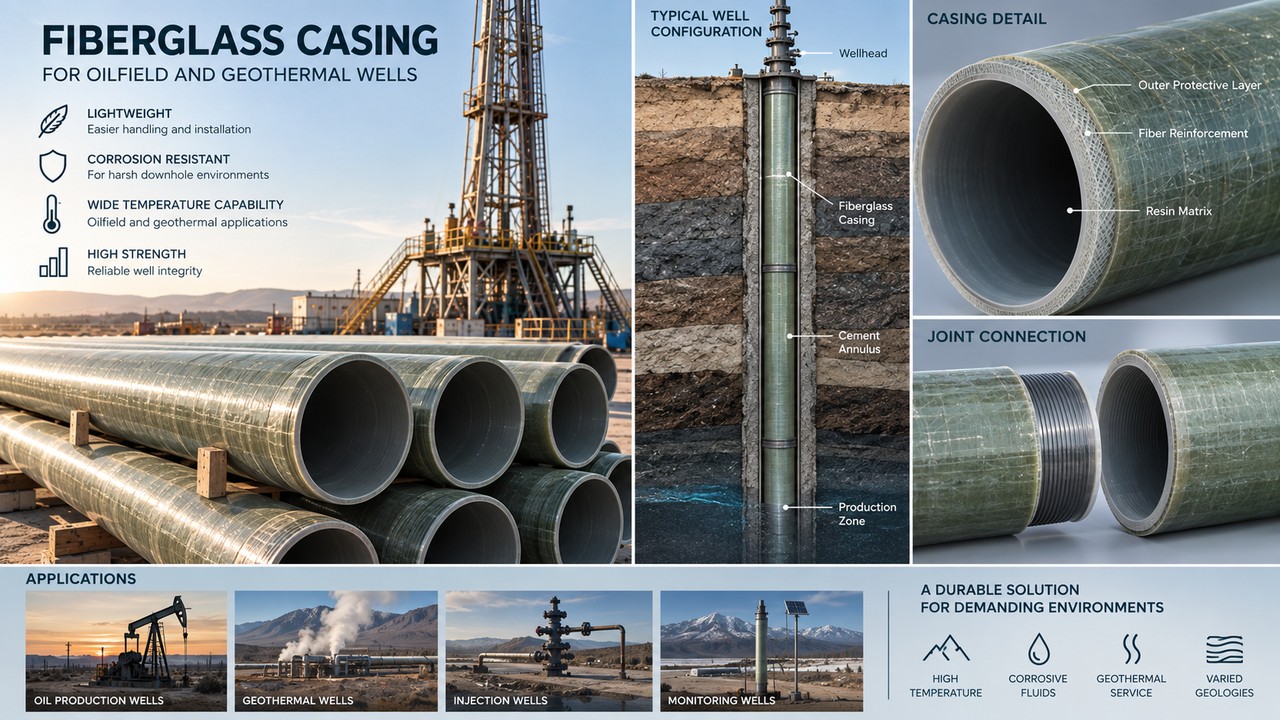
When your RFQ names fiberglass casing, you are choosing a glass-reinforced epoxy casing string for oilfield or geothermal well duty—not a glossary entry. On casing-damage repair, water-source, CBM, and related well programs where steel corrodes early, that choice steers diameter, pressure class, standards path, and which datasheet you ask IFGS to return from Dongying. This page shows what you should lock into your inquiry so your quote matches how IFGS builds fiberglass casing.
What fiberglass casing means on your well RFQ
On IFGS product pages, fiberglass casing is downhole GRE casing manufactured by micro-controlled filament winding of epoxy resin and high-strength glass fiber roving. You should treat it as a product-family decision: name the well duty, diameter and pressure class, then ask for the datasheet that confirms ratings for that duty.
Published characteristics include corrosion resistance, long service life, and light weight with low job costs. You must treat specific size and pressure ratings as confirmed on the datasheet for your duty—not as brochure inspection limits. IFGS states catalogue figures are general design parameters and cannot be used as an inspection basis alone.
For your primary option, open Fiberglass Casing.
Size, pressure, and standards: what your RFQ should name
Use this table when you shortlist diameter, pressure class, and standards path:
| Decision factor on your project | What IFGS publishes (reference) | What you should put in your RFQ |
|---|---|---|
| Diameter | Catalogue range DN100–DN250 | Target diameter within or beyond range; flag custom |
| Pressure grating | Catalogue range 10 MPa–25 MPa | Pressure class within or beyond range; flag engineering review |
| Standards on the casing page | API 15HR; SY/T 6267-2006 | Name the standards path your audit will follow |
| Inspection myth to avoid | Catalogue ranges are not a combined inspection rating | Request size-specific P–T rating and supporting documents |
| Custom beyond the range | Designed and produced per customer demands | Say what is undecided and what you need confirmed |
When your scope also needs GRE casing for well construction or repair, review GRE Casing.
You should treat catalogue ranges as reference only and request size-specific rating and connection limits for your duty.
Plain casing vs casing-and-screen assemblies on your well
If your well schedule mixes plain casing with screen sections, you are not writing the same RFQ as a plain casing string alone. On the sister assembly page, IFGS asks you to submit the casing and screen schedule, opening requirements, depth, and connection details. For screens, you should also list slot or hole dimensions, opening pattern, and formation information, plus fluid conditions, installation loads, inspection needs, and quantity.
When your RFQ covers casing-and-screen assemblies, review Fiberglass Well Casing And Screens. Request the drawing and technical data for the exact configuration offered before you order.
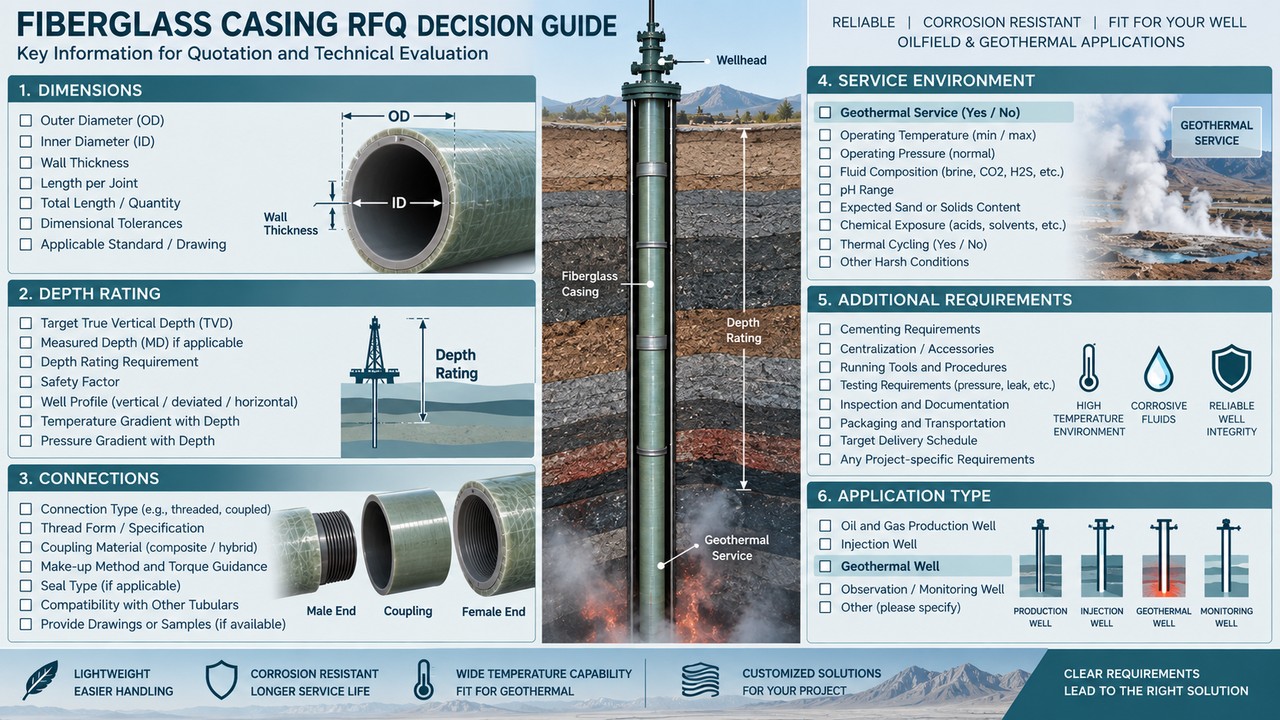
RFQ checklist: what you should send so the quote matches your string
Before you request a quotation, put these items in your inquiry:
- Well / duty context — casing damage repair, water source, CBM straight well, injection, or other; name oilfield or geothermal context when it applies.
- Target diameter — within or beyond DN100–DN250; flag custom.
- Pressure class — within or beyond 10–25 MPa; flag engineering review.
- Fluid, temperature, and depth — share what you can; mark undecided fields honestly.
- Standards you will audit — e.g. API 15HR and project documents you must satisfy.
- Quantity, length schedule, connections, delivery window and destination — enough for a Dongying manufacturing quote.
- Ask for the fiberglass casing datasheet by name — request verified dimensions, ratings, and supporting documents for the offered configuration.
IFGS also invites a practical request list covering product name, quantity, dimensions or rating, operating conditions, installation or drawing needs, standards, and delivery window. Include what you know and mark the rest as undecided.
Where fiberglass casing fits on your well program
IFGS manufactures GRE and FRP pipe systems in Dongying for oilfield and geothermal service where steel corrodes. You typically shortlist fiberglass casing when you need a corrosion-resistant nonmetallic casing string and are ready to name duty, diameter/pressure, and standards path. Published applications already listed include casing damage well repair, water source wells, CBM straight wells, and other duties per customer design.
Spec traps that slow your quote
You should watch for these gaps—they usually send a fiberglass casing RFQ back with clarifying questions instead of numbers:
- You wrote “fiberglass casing” but did not name well duty (repair, water source, CBM, or other).
- You listed only a diameter/pressure range and skipped size-specific ratings and connections.
- You treated catalogue figures as an inspection basis instead of requesting verified technical data.
- You mixed plain casing language with a casing-and-screen schedule without openings, depth, and connections.
- You asked for price only and skipped the datasheet request IFGS invites on the product pages.
Clean those five items and your inquiry is ready for a quote.
FAQ
What does “fiberglass casing” mean for your well RFQ?
For your inquiry, fiberglass casing means downhole GRE casing made by micro-controlled filament winding of epoxy resin and high-strength glass fiber roving. On IFGS pages, that family is for project-specific well installations where you confirm design against depth, dimensions, fluid conditions, external loads, and connections. You should name duty, diameter, pressure class, and standards path so the quote matches the datasheet family you need.
What diameter and pressure ranges should you treat as catalogue reference?
IFGS publishes a catalogue diameter range of DN100–DN250 and a pressure grating of 10 MPa–25 MPa on the fiberglass casing page. You should treat those figures as general product information and design parameters—not as a combined inspection rating for every size at the upper pressure. Ask for size-specific ratings, and flag custom design when your target sits beyond the published range.
Which standards path should you name on your casing RFQ?
On the live fiberglass casing page, IFGS references API 15HR Specification for High Pressure Fiberglass Line Pipe and SY/T 6267-2006 Specification for High Pressure Fiberglass Line Pipe. You should name which standards your project will audit and ask for the applicable edition, test documentation, and supporting documents for the proposed product rather than inferring fitness from a standard number alone.
When should you RFQ plain casing versus casing-and-screen assemblies?
Choose the plain fiberglass casing money page when your schedule is casing body and connections for a well duty such as repair, water source, or CBM. Choose the casing-and-screen sister when your well design mixes plain casing with screen sections and you must submit openings, depth, and connections. You should state which configuration you need so IFGS returns the right drawing and technical data.
What should you attach when you ask IFGS for a quotation?
You should attach well/duty context, target diameter and pressure class, fluid/temperature/depth information you can share, standards you will audit, quantity and length schedule, connection details, plus delivery window and destination. Ask for the fiberglass casing datasheet by name—IFGS invites you to request verified dimensions, ratings, and supporting documents for the exact size and configuration offered.
Can you use catalogue characteristics as your inspection limits?
No. IFGS lists corrosion resistance, long service life, and light weight with low job costs as published characteristics, but states that catalogue parameters are general information and cannot be used as an inspection basis alone. You should treat brochure characteristics as directional benefits and request verified technical data for inspection packages on your duty.
Does a published range prove every size at the upper pressure?
No. IFGS states that separate catalogue range limits are not a combined rating for your string. You should request the conditions and documents for the exact size and configuration offered, including size-specific pressure-temperature rating and connection limits, before you freeze inspection language in your RFQ or treat the upper pressure as proven for every diameter.
When your checklist is complete, open the money page linked above, request the fiberglass casing datasheet by name, and send IFGS your well duty, diameter and pressure class, standards path, fluid and depth details, connections, length/quantity schedule, and delivery window. That package lets your fiberglass casing quote rest on verified technical data for your string—not guesswork.