When your project needs high-pressure fiberglass line pipe for a surface or buried oil, water or multiphase line, your quote is only as good as the service data you send. You name the fluid, the operating, design and surge pressures, the temperature range, the diameter, the joint family and the installation, mark anything undecided as “Not sure yet”, and ask for the size-specific rating and documents. This page is your RFQ checklist, not a standards explainer.
What this checklist covers
This checklist is for rigid GRE/FRP line pipe on surface or buried lines. IFGS supplies high-pressure fiberglass line pipe as a matched pipe-and-joint system, and the right configuration for you depends on the conveyed fluid, design pressure, operating temperature and installation conditions. A technical datasheet is not published on the product page, so you request the applicable dimensions, ratings and supporting documents for your project instead of assuming values. Your quote path starts at High Pressure Fiberglass Line Pipe.
Keep two neighbours out of your RFQ. GRE tubing sits in a separate IFGS tubing family, and the line-pipe collection warns you not to mix spoolable API 15S RTP with 15HR or 15LR line pipe. If you want background on the standard text itself, read API SPEC 15HR 2016 High-Pressure Fiberglass Line Pipe Standard separately.
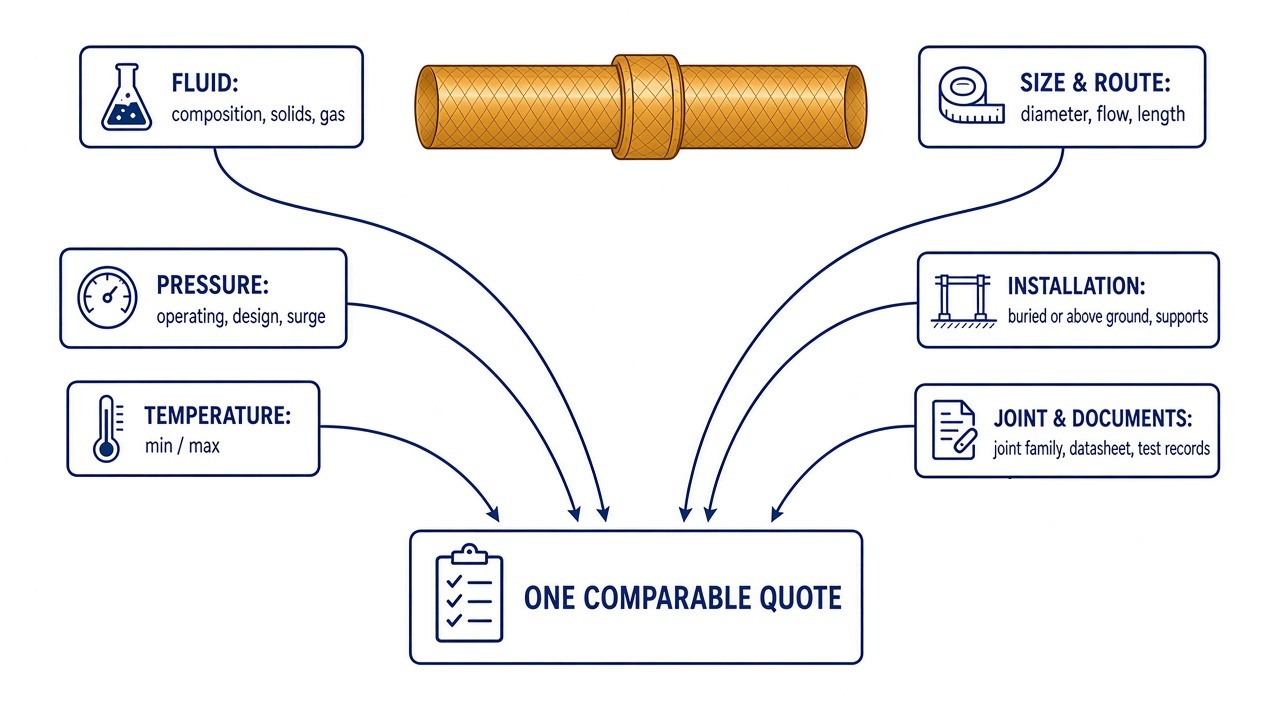
High-pressure fiberglass line pipe RFQ: fluid; pressure envelope; temperature; size and route; installation; joint family and documents.
Spec decisions your RFQ should name
Use this table when you turn your line design into a request:
| RFQ field | What IFGS asks for | What you put in your RFQ |
|---|---|---|
| Fluid | Composition, concentration, solids or gas content | Your fluid name, concentration, solids and any gas |
| Pressure | Normal operating, maximum design, surge conditions | All three values with units; say if surge is unknown |
| Temperature | Operating temperature range | Your minimum and maximum, with units |
| Size and route | Diameter, flow rate, pipe length, tie-in to existing equipment | Your diameter, flow rate, total length and tie-in points |
| Installation | Buried or above-ground, supports, external loading | Your burial or surface layout, supports and soil notes |
| Joint and documents | Joint details, test records, standard edition | Your joint family, the documents you need and the edition your tender cites |
RFQ checklist: what you send so your bids compare
Before you request a quotation, put these items in your inquiry:
- Product path: name High Pressure Fiberglass Line Pipe and your service (oil, water or multiphase).
- Fluid data: give your fluid composition, concentration, and any solids or gas content.
- Pressure envelope: state your normal operating pressure, maximum design pressure and surge conditions, each with units.
- Temperature range: give your minimum and maximum operating temperature, with units.
- Size and route: list your diameter, flow rate, pipe length and connections to existing equipment, and attach your drawing if you have one.
- Installation: say whether your line is buried or above ground, describe supports and external loading, and add soil or burial notes if abrasion sleeves or pads may be needed.
- Joint family: name the connection you need, or ask IFGS to propose the matched joint for your size.
- Documents: ask for a model-specific datasheet covering dimensions and tolerances, resin and reinforcement, the pressure-temperature rating, joint details and installation requirements, plus the applicable test records and the standard edition your project requires.
- Commercial: add your quantity, delivery destination and required delivery date.
Why the joint belongs in your pipe spec
The product page treats the pipe and its joint as one system, so any rating you compare should cover the offered size and connection together. Across its product pages, IFGS lists several joint families, including thread joints with fiberglass or stainless steel couplings, lamination and super lamination joints, adhesive bonded (cemented) joints, flanged joints and rubber-seal bell and spigot locked joints. You ask which family the offered size uses and confirm its details before you order. When you compare bids, require the same joint family and the same design envelope on every line item.
When your pressure points to the low-pressure range
If your design pressure sits low, compare Low-Pressure Fiberglass Line Pipe before you lock your RFQ. That page lists a production diameter range of DN50–DN2000 and a pressure range of 0–6.9 MPa, and it names API Spec 15LR among its product standards. Your design and surge pressures, not the product name, decide which family you request, so state them first.
Spec traps that slow your quote
- Pressure without surge: if you give only operating pressure, your bidders may rate the line on different assumptions.
- Numbers without units: you lose a review cycle when a pressure or temperature arrives without its unit.
- A standard without its edition: you name the standard and the edition your project requires, not just the letters.
- A standard reference read as certification: the product page says a reference to API 15HR is not a service-life statement or proof of certification, so you state the compliance documents you need.
- Missing burial notes: you attach soil or burial notes early, because abrasion sleeves or pads are easy to omit and expensive to add later.
FAQ
What do you need to send before IFGS can quote high-pressure fiberglass line pipe?
You send the fluid composition, the normal operating, maximum design and surge pressures, the operating temperature range, the diameter, flow rate and pipe length, and whether your line is buried or above ground. Add your joint requirement, quantity, delivery destination and required date. If a size, rating or quantity is undecided, you mark it “Not sure yet”, because partial information is enough to start a technical discussion with IFGS.
Does the product page publish a pressure rating for this pipe?
No. A technical datasheet is not published on the product page, so you will not find a size-specific rating there to copy into your tender. You share fluid composition, design conditions and installation details to request the size-specific rating and technical documentation. Confirm the dimensions, the pressure-temperature rating and the joint details for the offered size and connection before ordering, so your bid comparison rests on documents rather than assumptions.
Is an API 15HR reference the same as certification?
No. The product page states that a reference to the standard is not a service-life statement or proof of certification for a particular product. If your project needs compliance documentation, you state it in your inquiry by name, together with the standard edition your tender cites. You then ask for the applicable test records for the offered size, so your reviewer can check the documents against your project requirements.
Why does the joint change your quote?
IFGS supplies this pipe as a matched pipe-and-joint system, so the connection is part of what is rated and priced. If one bidder quotes a threaded joint and another a laminated or flanged joint, your line items no longer compare. You name the joint family you need, or ask IFGS to propose one, and require the same joint family and the same design envelope on every bid you evaluate.
Can you send an RFQ before every detail is fixed?
Yes. The product page invites you to start with your application and the details you know, and to mark anything undecided as “Not sure yet”. If you are still defining the specification, you can start with a technical review instead of a quotation request. Tell IFGS what you need to confirm, such as a size or a rating, and send your drawing or project specification if one already exists.
Is this the same product as GRE tubing or spoolable RTP?
No. This checklist covers rigid fiberglass line pipe for surface or buried lines. GRE tubing sits in a separate IFGS tubing family, and the line-pipe collection tells you not to mix spoolable API 15S RTP with 15HR or 15LR line pipe, because RTP is a different product family on the site. Keep each family in its own RFQ, so your bidders quote the same scope and your comparison stays clean.
When your service data, pressure envelope, temperature range, joint family and document list sit in one inquiry, your bidders can quote the same line and you can compare their answers directly. IFGS sources from licensed partner factories in China and worldwide, and confirms product suitability and document availability for your specific project. Start from the High Pressure Fiberglass Line Pipe page linked above and send your conditions and drawing with your quantity and delivery date.