When your RFQ names API 15HR or API 15LR for GRE tubing, you are choosing a pressure and service envelope for quotation—not asking for another standards history page. You confirm high-pressure versus low-pressure fiberglass line-pipe designation, whether your application is a well or a surface line, and which datasheet fields IFGS needs before quoting. This page is an application and spec checklist so your quote matches the right envelope.
What API 15HR and API 15LR mean on your GRE tubing RFQ
On the live IFGS product pages, API 15HR is High Pressure Fiberglass Line Pipe, and API 15LR is Low Pressure Fiberglass Line Pipe. You treat those names as standard designations—not as a 15-hour design life. State the required service life and design basis separately on your inquiry.
For API 15HR enquiries, you confirm the intended service and applicable product specification, then submit well or pipeline conditions and the connection drawing for configuration review. For API 15LR, you identify surface line versus well, and request the applicable specification, dimensions, and rating for the proposed pipe-and-joint assembly. For your primary high-pressure path, open API 15HR GRE Tubing.
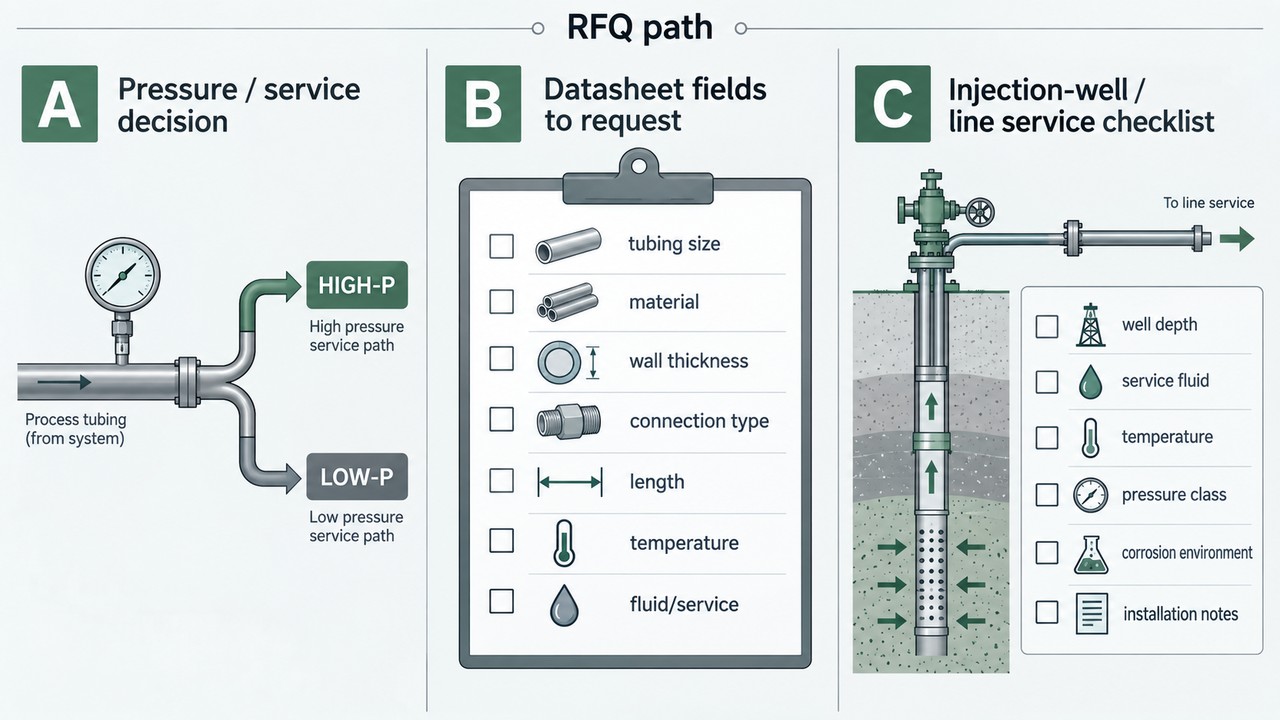
Spec decisions your RFQ should name
Use this table when you shortlist API 15HR versus API 15LR for GRE tubing on pressure, service, and documents:
| Decision factor on your project | What IFGS publishes (reference) | What you should put in your RFQ |
|---|---|---|
| Spec name — HR | API 15HR = High Pressure Fiberglass Line Pipe; not a 15-hour design life | Name API 15HR; state required service life and design basis separately |
| Spec name — LR | API 15LR = Low Pressure Fiberglass Line Pipe | Name API 15LR; say surface line or well |
| HR catalogue envelope | Diameter DN40–DN100; pressure rating 10 MPa–25 MPa (reference ranges) | Target size and design/operating pressure with units; ask size-specific P–T |
| HR service notes | Water injection, reinjection, or polymer injection: specify well conditions; do not infer downhole suitability from a line-pipe standard number alone | Well duty, depth, completion, installed length |
| LR application gate | Designation does not establish suitability for high-pressure drilling or downhole tubing | If the duty is a well, state that and ask which product spec applies |
| Shared project inputs | Well duty; fluid/temperature; internal/external pressure; axial/combined loads; dimensions, connections, installation | Mark undecided fields “Not sure yet” |
| Industry scope (GRE tubing page) | Published API scope ranges are industry figures, not IFGS product ratings | Use as orientation only; request the IFGS datasheet for the duty |
| Sister compare | API 15LR GRE Tubing and GRE Tubing product pages | Say why HR vs LR, or open the general GRE tubing path |
| Documents | Request product datasheet, connection information, and qualification documents | Ask by name; team confirms availability and version |
When you need the low-pressure sister path, review API 15LR GRE Tubing. When your inquiry is still at the family level before you freeze HR or LR, review GRE Tubing. Treat published catalogue and industry scope figures as reference limits, and request the datasheet for the offered configuration.
RFQ checklist: what you should send so the quote matches your envelope
Before you request a quotation, include these items:
- Named envelope — API 15HR or API 15LR — and whether your duty is a well or a surface / pipeline line.
- Well or pipeline conditions — application, well depth, completion arrangement, installed length, or surface-line notes.
- Fluid, operating and design temperature, operating and design pressure — with units; include differential conditions where known.
- Axial and combined loads — or flag what needs engineering review.
- Dimensions, connections, and installation — thread or connection drawings, seals, interfaces, handling.
- Inspection, requested service life, and documentation for project approval.
- Quantity, delivery destination, and delivery window for an IFGS quotation.
- Technical documents by name — product datasheet, connection information, and qualification documents; the team confirms availability and version.
Mark undecided fields as “Not sure yet”—partial information is enough to start. On API 15HR, catalogue diameter and pressure ranges are reference ranges: you request size-specific pressure-temperature and connection limits; a range does not prove every size at the upper pressure. On API 15LR, a technical datasheet is not published—you request dimensions, ratings, and supporting documents for your project.
Where each envelope fits on your tubing scope
You shortlist API 15HR GRE Tubing when your inquiry needs the high-pressure fiberglass line-pipe designation and you can send well or pipeline conditions plus connection details. You shortlist API 15LR GRE Tubing when you need the low-pressure designation and can state surface line versus well. You open GRE Tubing when you still need a project-specific discussion before you lock HR versus LR. The GRE Tubing page also publishes an industry API specification-scope table for orientation; those figures are not IFGS product ratings—confirm ratings on the IFGS datasheet for your duty.
Spec traps that slow your quote
You should watch for these gaps—they usually return clarifying questions instead of numbers:
- You treated “API 15HR” as a 15-hour design life instead of High Pressure Fiberglass Line Pipe.
- You named API 15LR for a well without stating well versus surface line.
- You inferred downhole suitability from a line-pipe number alone without well conditions.
- You treated DN40–DN100 / 10–25 MPa as a combined guaranteed rating for every size.
- You pasted industry API scope psi ranges as if they were IFGS product ratings.
- You asked for price only and skipped the datasheet, connections, quantity, and delivery window.
Clean those gaps—your inquiry is ready.
FAQ
What does API 15HR mean on your GRE tubing RFQ?
On your inquiry, API 15HR is the IFGS-referenced specification titled High Pressure Fiberglass Line Pipe. You confirm the intended service and applicable product specification, then send well or pipeline conditions and the connection drawing so the offered configuration can be reviewed. You should not treat “15HR” as a 15-hour design life—state the required service life and design basis separately.
What does API 15LR mean on your GRE tubing RFQ?
On your inquiry, API 15LR is the specification for Low Pressure Fiberglass Line Pipe. You identify whether the requirement is for a surface line or a well application, and you request the applicable specification, dimensions, and rating for the proposed pipe-and-joint assembly. The designation alone does not establish suitability for high-pressure drilling or downhole tubing.
When should you choose the API 15HR path instead of API 15LR?
You should shortlist API 15HR GRE Tubing when your RFQ needs the high-pressure fiberglass line-pipe designation and you can supply service conditions—including injection, reinjection, or polymer injection notes when those duties apply. You should shortlist API 15LR when you need the low-pressure designation and can state surface line versus well clearly. Name the path so IFGS does not quote the wrong envelope.
What catalogue envelope should you check first on API 15HR GRE Tubing?
On the live API 15HR GRE Tubing page, catalogue reference ranges list diameter DN40–DN100 and pressure rating 10 MPa–25 MPa. You should treat those figures as reference ranges—not as a guaranteed combined rating for every diameter and duty. Ask IFGS for the size-specific pressure-temperature rating and connection limits against your target size and design pressure.
Can you infer downhole tubing suitability from a line-pipe standard number alone?
No. The live API 15HR page states that for downhole water injection, reinjection, or polymer injection, you specify the well conditions and the required tubing standard, and you do not infer downhole suitability from a line-pipe standard number alone. Ask IFGS to identify the applicable specification, edition, and test documentation for the proposed product.
Are the API scope pressure ranges on the GRE Tubing page IFGS product ratings?
No. The live GRE Tubing page states that the industry-published API specification-scope figures describe what the applicable API specifications and the GRE material class permit—they are not IFGS product ratings. You use them as orientation only. Actual size, pressure, and temperature ratings for your string are confirmed on the IFGS datasheet for the duty you submit.
What should you attach when you ask IFGS for a quotation?
You should attach the named envelope (API 15HR or API 15LR); well or pipeline conditions; fluid, temperature, and pressure with units; axial and combined loads or review flags; dimensions, connection drawings, and installation notes; inspection needs; plus quantity, destination, and delivery window. Ask for the product datasheet, connection information, and qualification documents by name so the team can confirm availability and version.
When your checklist is complete, open the API 15HR GRE Tubing page linked above (or the API 15LR sister when that envelope fits), request the datasheet for the duty that matches your string, and send IFGS your service notes, pressures, temperatures, connections, quantity, and delivery window. That package lets your GRE tubing quote rest on verified technical data—not guesswork.