When your tender cites double-wall storage—or even names UL 58 as familiar steel-UST language—you still need to choose a wall type before IFGS can quote. You name FF (fiberglass-fiberglass) or SF (steel-inner + composite outer), state capacity, medium, site conditions, and interstitial monitoring, then map those fields to the Dongying product path. This page is a commercial RFQ and spec checklist—not another UL 58 encyclopedia.
What FF and SF mean on your double-wall tank RFQ
On the live IFGS product pages, FF means a fiberglass-fiberglass double-wall composite tank: both walls are fiberglass, fabricated by winding and jetting of fiberglass reinforcing materials and resin as the base. SF means a steel inner tank with a composite outer barrier—an impermeable shell formed outside a single-layer steel tank by spray and contact forming with glass-fiber reinforcement and a resin matrix. You treat those names as construction choices for quotation, not as invented UL seals.
For FF enquiries, you define the stored medium, capacity, site conditions, and interstitial monitoring. The live FF page lists Product Standard SH/T 3177-2015 (The Technical Specification of Buried FF Double Walled Tank Used for Gas Station) as a published reference—you still name the code or owner spec that drives your project. For your primary FF quote path, open FF Double Walled Tanks.
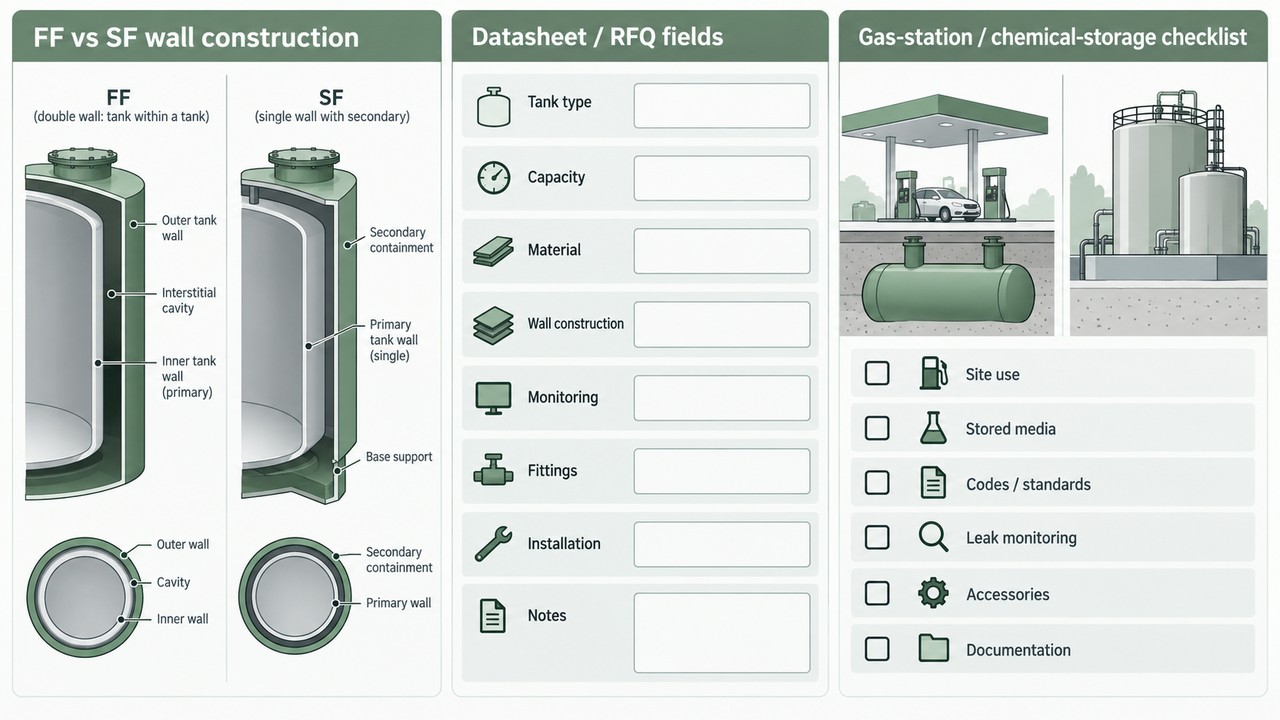
Spec decisions your RFQ should name
Use this table when you shortlist FF versus SF double-wall tanks on wall type, capacity, medium, and documents:
| Decision factor on your project | What IFGS publishes (reference) | What you should put in your RFQ |
|---|---|---|
| Wall type — FF | Fiberglass-fiberglass double-wall; winding and jetting of FRP materials and resin | Name FF; do not invent a UL listing |
| Wall type — SF | Steel inner + composite outer (spray + contact forming; glass fiber + resin) | Name SF; state steel-inner + composite outer |
| Catalogue envelope (both) | Diameter ≤ 4 m; capacity ≤ 100 m³ (reference ranges) | Target diameter and capacity with units |
| FF product standard (page) | SH/T 3177-2015 for buried FF double-walled tanks used for gas stations | Name SH/T 3177-2015 when it applies, or your owner code |
| Applications (FF page) | Product-oil storage in gas stations; hazardous chemicals in chemical plants | State medium and site duty clearly |
| Shared project inputs | Application/environment; dimensions/connections/materials; quantity/docs | Mark undecided fields “Not sure yet” |
| Interstitial monitoring | Clarify hardware in IFGS scope vs owner-furnished | Say what monitoring you need and who supplies it |
| Listings / approvals | IFGS will not claim a listing your project did not name | Attach the code/owner language that drives double-wall |
| Documents | Request datasheet, connection info, qualification docs | Ask by name; team confirms availability/version |
When you need the steel-inner sister path, review SF Double Walled Tanks. When your inquiry is still at the family level before you freeze FF or SF, review Double Walled Tanks. Treat published catalogue ranges as reference limits, and request the datasheet for the offered configuration.
RFQ checklist: what you should send so the quote matches your wall type
Before you request a quotation, include these items:
- Named wall type — FF or SF — fiberglass-fiberglass versus steel-inner + composite outer.
- Stored medium and application — product oil at a gas station, hazardous chemical plant storage, or your stated duty.
- Capacity and diameter — with units; catalogue reference ranges are diameter ≤ 4 m and capacity ≤ 100 m³.
- Site conditions — buried or other arrangement notes that affect design.
- Interstitial monitoring — leak-detection approach, and whether hardware is in IFGS scope or owner-furnished.
- Code or owner spec that drives double-wall — for FF where it applies, SH/T 3177-2015 is on the live page; if your tender only cites UL 58 / double-wall language, say so and ask which project docs IFGS can quote against.
- Connections, nozzles, and interfaces — or mark “Not sure yet.”
- Quantity, delivery destination, and delivery window for a Dongying quotation.
- Technical documents by name — datasheet, connection information, and qualification documents; the team confirms availability and version.
Mark undecided fields as “Not sure yet”—partial information is enough to start. Catalogue diameter and capacity figures are reference ranges: you request configuration-specific limits so the quote matches your project.
Where each wall type fits on your tank scope
You shortlist FF Double Walled Tanks when your inquiry needs fiberglass-fiberglass walls and you can name medium, capacity, site conditions, and monitoring. You shortlist SF Double Walled Tanks when you need a steel inner tank with a composite outer barrier. You open Double Walled Tanks when you still need a family-level discussion—secondary containment plus leak-detection—before you lock FF versus SF. Name Lined FF or SF Double Wall Underground Tank only when that SKU path is clear.
Spec traps that slow your quote
You should watch for these gaps—they usually return clarifying questions instead of numbers:
- You pasted UL 58 as if it were an IFGS product standard (UL 58 is steel UST language buyers may cite; IFGS quotes against wall type + project docs you name).
- You asked for a UL / CE / ISO seal IFGS did not publish for these tanks.
- You named double-wall without saying FF or SF.
- You omitted medium, capacity, or interstitial monitoring.
- You treated ≤4 m / ≤100 m³ as a guaranteed combined envelope for every configuration.
- You asked for price only and skipped the datasheet, connections, quantity, and delivery window.
Clean those gaps—your inquiry is ready.
FAQ
What does FF mean on your double-wall tank RFQ?
On your inquiry, FF means a fiberglass-fiberglass double-wall composite tank. You define the stored medium, capacity, site conditions, and interstitial monitoring so IFGS can review the offered configuration. Fabrication uses winding and jetting of fiberglass reinforcing materials and resin as the base. You should not invent a UL listing—name the project code or owner spec that drives your double-wall requirement.
What does SF mean on your double-wall tank RFQ?
On your inquiry, SF means a steel inner tank with a composite outer barrier. The impermeable outer shell is formed outside a single-layer steel tank by spray and contact forming with glass-fiber reinforcement and a resin matrix. You send the same project inputs—medium, capacity, site notes, monitoring—so the quote matches the steel-plus-composite path rather than FF.
When should you choose the FF path instead of SF?
You should shortlist FF Double Walled Tanks when your RFQ needs fiberglass-fiberglass walls and you can supply medium, capacity, site conditions, and monitoring. You should shortlist SF when you need a steel inner tank with a composite outer barrier. Name the wall type so IFGS does not quote the wrong construction. If you are still deciding, open the Double Walled Tanks family page first.
What catalogue envelope should you check first on IFGS double-wall tanks?
On the live FF and SF product pages, catalogue reference ranges list diameter ≤ 4 m and capacity ≤ 100 m³. You should treat those figures as reference ranges—not as a guaranteed combined rating for every configuration and duty. Ask IFGS for the configuration-specific limits against your target size, medium, and site conditions.
If your tender cites UL 58, can IFGS quote a UL 58 tank?
Not as an invented UL 58 product listing. UL 58 is steel underground-tank language your tender may cite; IFGS will not claim a UL 58 / UL 1316 / UL 1746 listing your project did not name. You name wall type (FF or SF), capacity, medium, and monitoring, and you attach the owner or project documents IFGS can quote against—for FF, the live page publishes SH/T 3177-2015 where that path applies.
What applications does the FF page publish for your planning?
The live FF Double Walled Tanks page states applications for storage of product oil in gas stations and storage of hazardous chemicals in chemical plants. You still state your exact medium and site duty on the RFQ. Tanks can be designed and produced according to customer demands within the quoted configuration—you send the checklist fields so engineering review stays grounded.
What should you attach when you ask IFGS for a quotation?
You should attach named wall type (FF or SF); stored medium; capacity and diameter; site conditions; interstitial monitoring scope; the code or owner spec that drives double-wall; connection notes; plus quantity, destination, and delivery window. Ask for the datasheet, connection information, and qualification documents by name so the team can confirm availability and version.
When your checklist is complete, open the FF Double Walled Tanks page linked above (or the SF sister when that wall type fits), request the datasheet for the duty that matches your storage scope, and send IFGS your medium, capacity, site notes, monitoring, quantity, and delivery window. That package lets your double-wall tank quote rest on verified project fields—not guesswork.