When your completion or sand-control RFQ names a GRE screen tube—or asks for a fiberglass sieve section with project-defined holes or slots—you still need a screen schedule before IFGS can quote. You state diameter, pressure envelope, opening pattern, formation or particle information, connections, and loading notes, then map those fields to the matching partner-factory product path. This page is a commercial RFQ and spec checklist—not a well case study or GRE tubing encyclopedia.
What a GRE screen tube means on your sand-control RFQ
On the live IFGS product page, a GRE screen tube is a glass-reinforced epoxy screen section with project-defined holes or slots. You specify well conditions, dimensions, opening pattern, and loading requirements so the screen section and its connections can be reviewed. Catalogue reference ranges list diameter DN100–DN250 and pressure rating 10 MPa–25 MPa—you treat those as reference limits, not a guaranteed combined rating for every configuration.
For construction language on the sister screen-pipe listing, GRE screen pipes use glass-fibre reinforcement and an epoxy resin matrix: wound GRE pipe that is subsequently bored or slotted to form a screen. You still send your own slot or hole dimensions and formation notes—IFGS will not invent a slot chart your project did not supply. For your primary quote path, open GRE Screen Tube.
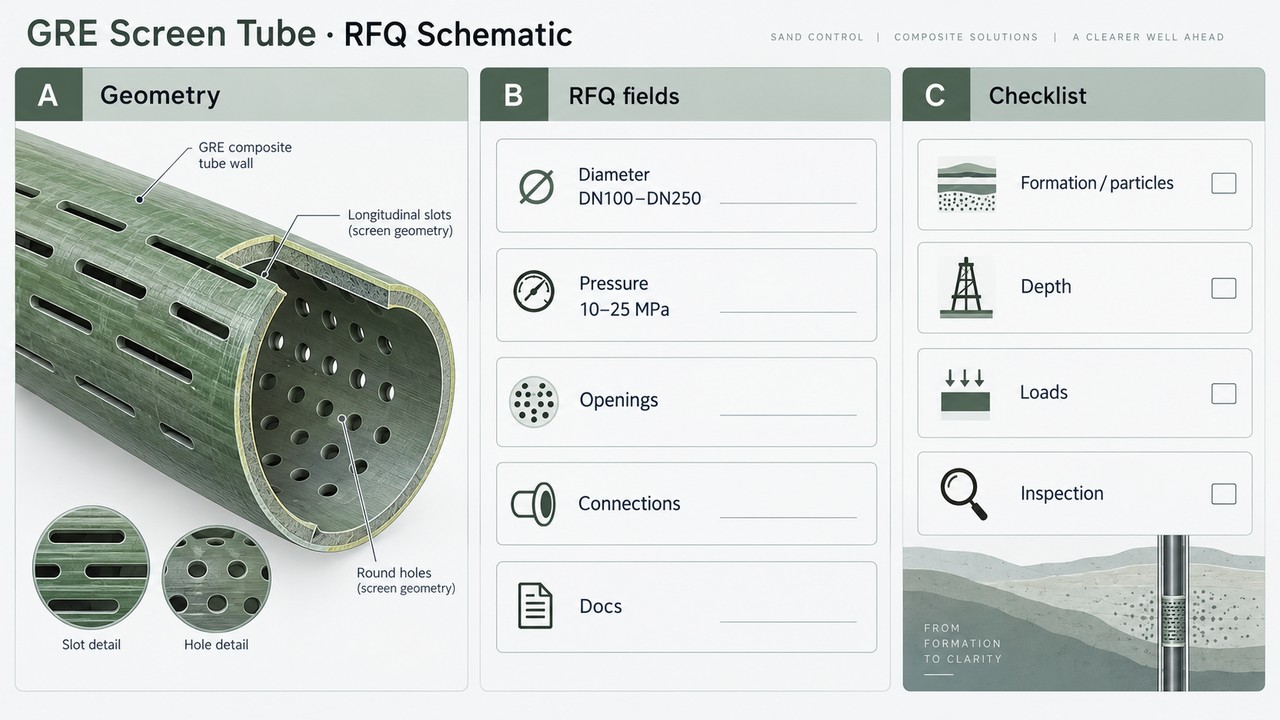
Spec decisions your RFQ should name
Use this table when you shortlist a GRE screen tube on openings, diameter, pressure envelope, connections, and documents:
| Decision factor on your project | What IFGS publishes (reference) | What you should put in your RFQ |
|---|---|---|
| Product path | GRE screen tubes with project-defined holes or slots | Name GRE screen tube (not generic line pipe or RTP) |
| Catalogue diameter | DN100–DN250 (reference range) | Target diameter with units |
| Catalogue pressure | 10 MPa–25 MPa (reference range) | Design / operating pressure envelope with units |
| Openings | Slot or hole dimensions, opening pattern (project-defined) | Slot/hole size, pattern, open-area language if you have it |
| Formation / particles | Formation or particle-size information used to select openings | Sand-control intent or particle data in plain language |
| Geometry & connections | Pipe diameter, wall thickness, screen length, connection details | Drawing or schedule; mark undecided “Not sure yet” |
| Well / loads | Well depth, casing or screen schedule; installation loads | Depth, surrounding assembly, mechanical loading notes |
| Fluid conditions | Fluid composition, operating temperature, relevant pressure | Fluid, temperature, and service notes that affect selection |
| Shared project inputs | Application/environment; dimensions/connections/materials; quantity/docs | Partial info is enough; mark gaps “Not sure yet” |
| Documents | Drawing, datasheet, connection info, qualification docs | Ask by name; team confirms availability/version |
When you need the sister screen-pipe listing for opening and geometry language, review GRE Screens Pipes. When your inquiry is still at the family level before you freeze a SKU, review GRE SCREEN TUBE. Treat published catalogue ranges as reference limits, and request the drawing and datasheet for the offered configuration.
RFQ checklist: what you should send so the quote matches your screen schedule
Before you request a quotation, include these items:
- Named product path — GRE screen tube — sand-control / completion screen section, not generic GRE tubing or line pipe.
- Diameter and pressure envelope — with units; catalogue reference ranges are DN100–DN250 and 10 MPa–25 MPa.
- Slot or hole dimensions and opening pattern — or sand-control intent in plain language if a formal slot drawing is not ready.
- Formation or particle-size information used to select the openings.
- Well depth, casing or screen schedule, screen length, and wall notes — share a drawing or project specification if available.
- Connection details — threaded ends or other interfaces you need reviewed with the screen section.
- Fluid conditions, installation loads, and inspection requirements.
- Quantity, delivery destination, and delivery window for an IFGS quotation.
- Technical documents by name — drawing, product datasheet, connection information, and qualification documents; the team confirms availability and version.
Mark undecided fields as “Not sure yet”—partial information is enough to start. Catalogue diameter and pressure figures are reference ranges: you request configuration-specific limits so the quote matches your project. If your tender mixes screen tube with line pipe or RTP, split the RFQ—different manufacturing and inspection packs apply.
Where a GRE screen tube fits on your well scope
You shortlist GRE Screen Tube when your inquiry needs a project-defined hole or slot screen section and you can name diameter, pressure notes, openings, formation data, and connections. You open GRE Screens Pipes when you are still aligning pipe geometry, slot or hole pattern, formation conditions, and installation loads against a matched screen drawing. You open GRE SCREEN TUBE (family) when you need to compare related SKUs—screen tube, screen tubing, or screens pipes—before you lock one path. When your scope is a casing-plus-screen assembly rather than a screen-tube SKU alone, review Fiberglass Well Casing And Screens and submit the casing and screen schedule together.
Spec traps that slow your quote
You should watch for these gaps—they usually return clarifying questions instead of numbers:
- You asked for a slot chart IFGS did not invent—openings are project-defined; you supply sizes or sand-control intent.
- You named screen without diameter, pressure envelope, or connection details.
- You mixed screen tube with line pipe or RTP on one RFQ without splitting scopes.
- You treated DN100–DN250 / 10–25 MPa as a guaranteed combined envelope for every configuration.
- You asked for a CE / ISO / API seal IFGS did not publish on the live screen-tube body for your project.
- You asked for price only and skipped the drawing, datasheet, openings, quantity, and delivery window.
Clean those gaps—your inquiry is ready.
FAQ
What is a GRE screen tube on your sand-control RFQ?
On your inquiry, a GRE screen tube is a glass-reinforced epoxy screen section with project-defined holes or slots. You specify well conditions, dimensions, opening pattern, and loading requirements so IFGS can review the screen section and its connections. Catalogue reference ranges list diameter DN100–DN250 and pressure rating 10 MPa–25 MPa. You should not invent a slot chart—name the openings or sand-control intent your project actually uses.
What opening details should you send before IFGS can quote?
You should send slot or hole dimensions, opening pattern, and the formation or particle-size information used to select those openings. If a formal slot drawing is not ready, bring sand-control intent in plain language. On the sister GRE Screens Pipes page, selection also depends on pipe diameter, wall thickness, screen length, and connection details. Mark undecided fields “Not sure yet” so technical review can still start.
What catalogue envelope should you check first on IFGS GRE screen tube?
On the live GRE Screen Tube page, catalogue reference ranges list diameter DN100–DN250 and pressure rating 10 MPa–25 MPa. You should treat those figures as reference ranges—not as a guaranteed combined rating for every configuration and duty. Ask IFGS for the configuration-specific limits against your target size, openings, fluid conditions, and installation loads. Request the drawing and datasheet for the offered screen section.
How should you separate GRE screen tube from casing-and-screen assemblies?
You should shortlist GRE Screen Tube when your RFQ is for a screen-tube SKU with project-defined openings and connections. You should open Fiberglass Well Casing And Screens when your well design needs casing and screen assemblies matched to a casing and screen schedule. Name which path you want so IFGS does not quote the wrong scope. If you are still comparing family SKUs, start on the GRE SCREEN TUBE category page.
What construction language does IFGS publish for GRE screen pipes?
On the live GRE Screens Pipes page, GRE screen pipes use glass-fibre reinforcement and an epoxy resin matrix. That listing describes wound GRE pipe that is subsequently bored or slotted to form a screen. You still confirm material compatibility, dimensions, connection details, and the conditions applicable to any published rating on the offered drawing. You should pair screen-tube questions with fluid notes so resin choices are not guessed on the sales side.
What documents should you request with your GRE screen tube quotation?
You should request the drawing and technical data for the exact configuration offered, plus the product datasheet, connection information, and qualification documents needed for your project. The IFGS team confirms document availability and the applicable version. You also include quantity, delivery destination, and delivery window. List pipe body, fittings, accessories, and documentation you need in the quotation so scope stays clear.
What should you attach when you ask IFGS for a quotation?
You should attach named product path (GRE screen tube); diameter and pressure envelope; slot or hole dimensions and opening pattern; formation or particle information; well depth and screen schedule; connection notes; fluid and load notes; plus quantity, destination, and delivery window. Ask for the drawing, datasheet, connection information, and qualification documents by name. Partial information is enough to start—mark gaps “Not sure yet.”
When your checklist is complete, open the GRE Screen Tube page linked above (or the GRE Screens Pipes sister when that listing fits), request the drawing and datasheet for the duty that matches your sand-control scope, and send IFGS your openings, diameter, pressure notes, formation data, connections, quantity, and delivery window. That package lets your GRE screen tube quote rest on verified project fields—not guesswork.