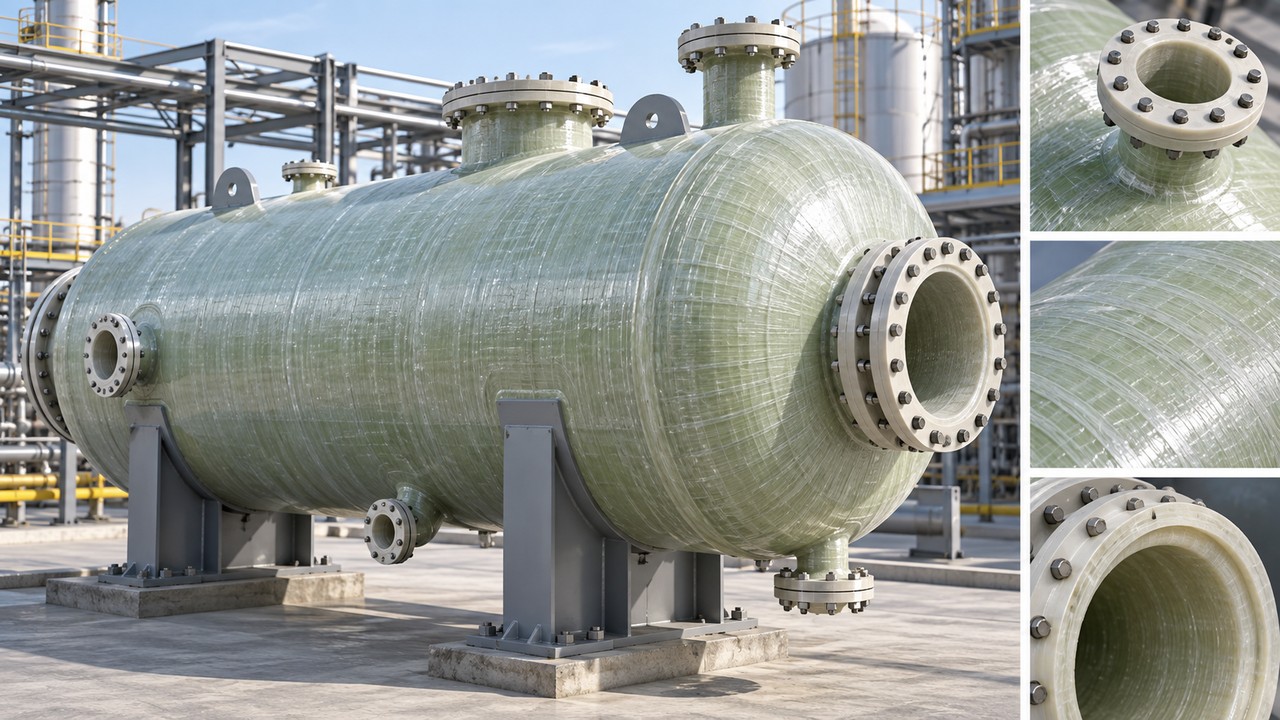
When your RFQ names GRP pressure vessels (or a GRP pressure vessel), you are specifying a filament-wound FRP vessel for a defined pressure service—not a storage-tank UL explainer. On oil, water and gas separator, filter, absorber, or reactor duty, you lock medium, volume, pressure and vacuum, temperature, and connection layout before IFGS reviews a vessel-specific design. This page shows what to put in your inquiry so your quote matches the configuration you need.
What a GRP pressure vessel means on your RFQ
On the IFGS product page, a GRP Pressure Vessel is a GRP vessel for a defined pressure service. You submit the medium, volume, pressure and vacuum conditions, temperature, and connection layout for review of a vessel-specific design. Catalogue information asks you to request the conditions and documents for the exact size and configuration offered—separate range limits are not a combined rating.
You will see product-at-a-glance scope on the live page: diameter ≤ 4000 mm; capacity ≤ 150 m³; product of inner diameter and pressure ≤ 2.4 MPa·m. Manufacturing is described as 3-dimensional enveloped winding with glass fiber reinforcing materials and a resin base, able to withstand certain pressure. The published product standard is Q/SXD 007-2017 Fiberglass Reinforced Thermosetting Resin Pressure Vessel. Applications listed for your review include oil, water and gas three-phase separator, filter, absorber, reactor, and other fields.
For your primary product path, open GRP Pressure Vessel.
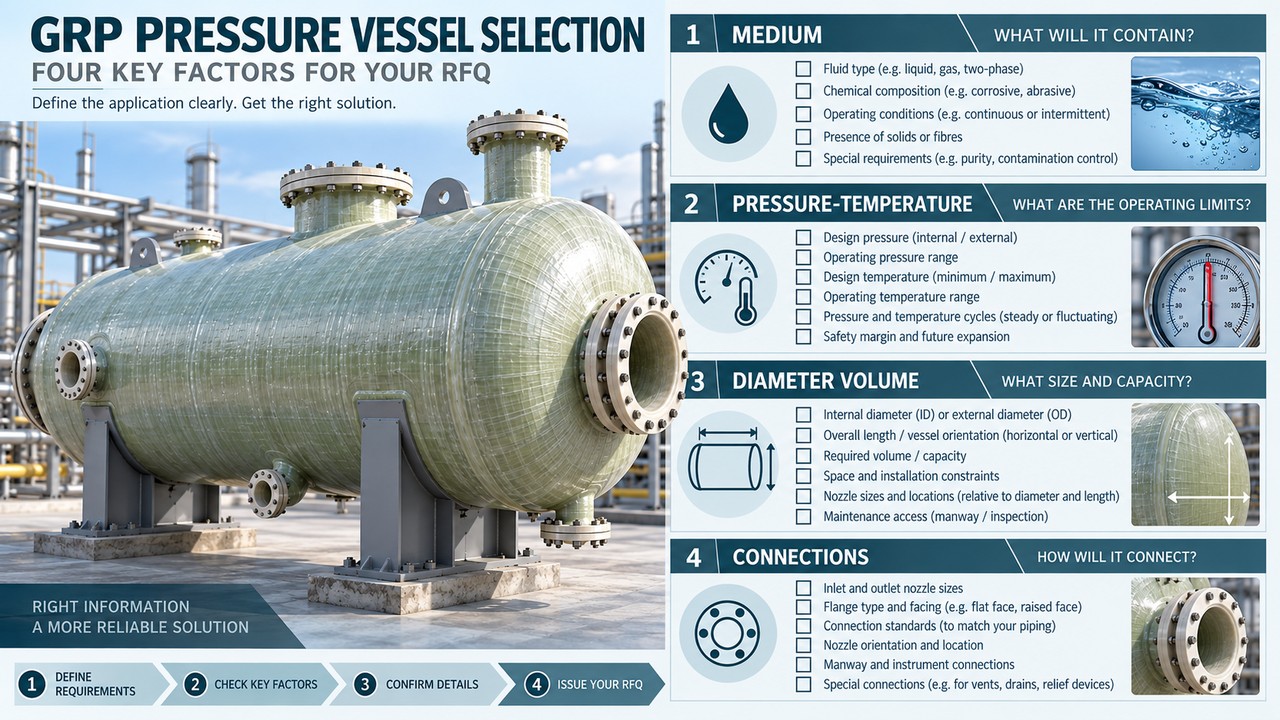
Spec decisions your RFQ should name
Use this table when you shortlist a vessel against duty, size, and documents:
| Decision factor on your project | What IFGS publishes (reference) | What you should put in your RFQ |
|---|---|---|
| Duty / application | Oil, water and gas three-phase separator; filter; absorber; reactor and other fields | Name separator, filter, absorber, reactor, or other service; describe the environment |
| Medium & conditions | Submit medium, volume, pressure and vacuum, temperature, connection layout | Medium; operating/design P; vacuum if any; temperature; connection layout |
| Diameter / capacity scope | Diameter ≤ 4000 mm; capacity ≤ 150 m³ | Target diameter and working volume with units |
| ID × pressure limit | Product of inner diameter and pressure ≤ 2.4 MPa·m | Your ID and design pressure so the limit can be checked |
| Catalogue myth | Separate range limits are not a combined rating | Request vessel-specific conditions and documents—not a brochure combo rating |
| Manufacturing path | 3-dimensional enveloped winding; glass fiber + resin; can withstand certain pressure | Note filament-wound GRP/FRP expectation; ask for offered configuration confirmation |
| Product standard | Q/SXD 007-2017 Fiberglass Reinforced Thermosetting Resin Pressure Vessel | Name project standards/approvals you must satisfy alongside this reference |
| Selection checklist | Intended application; dimensions/connections/materials; quantity and documents; “Not sure yet” OK | Mark undecided fields; partial information is enough to start |
When your scope sits in the tanks family alongside storage options, review Storage Tanks. When your line scope also needs GRE/FRP/RTP piping into or out of the vessel, review Non-metallic pipes. Treat published scope figures as catalogue limits and request the datasheet for the exact configuration offered.
RFQ checklist: what you should send so the quote matches your vessel
Before you request a quotation, include these items:
- Intended application and service environment — separator, filter, absorber, reactor, or other; oil / water / gas duty; operating conditions that affect selection.
- Medium, volume, pressure and vacuum, temperature — with units; flag vacuum or unusual temperature windows.
- Dimensions, connections, and material requirements — diameter/capacity targets; nozzle/connection layout; share a drawing or project specification if available.
- ID × pressure check — confirm your inner diameter and design pressure against the published ≤ 2.4 MPa·m product limit.
- Quantity and required documents — items to supply; applicable project standards or approvals.
- Quantity, delivery destination, and delivery window — enough for an IFGS quotation.
- Ask for technical documents by name — product datasheet, connection information, and qualification documents; the team confirms availability and applicable version.
Include what you know and mark undecided fields as “Not sure yet”—partial information is enough to start a technical discussion.
Where GRP pressure vessels fit on your process scope
You shortlist a GRP pressure vessel when your duty needs a filament-wound FRP vessel for defined pressure service in oil, water, and gas fields—separator, filter, absorber, reactor, or related applications. Open GRP Pressure Vessel first for vessel-specific design review, then use Storage Tanks if you are comparing storage families, or Non-metallic pipes when your RFQ also covers GRE/FRP/RTP lines tied to the vessel.
Spec traps that slow your quote
You should watch for these gaps—they usually send a GRP pressure vessel RFQ back with clarifying questions instead of numbers:
- You wrote “GRP pressure vessel” but skipped medium, volume, pressure and vacuum, temperature, and connection layout.
- You treated diameter, capacity, and ID×P limits as a combined rating instead of requesting vessel-specific documents.
- You mixed storage-tank UL language into a pressure-vessel inquiry without stating the pressure service and application class.
- You asked for price only and skipped the datasheet, connection information, and qualification documents the product page invites.
- You omitted quantity, delivery destination, and delivery window needed for quotation.
Clean those gaps—your inquiry is ready to quote.
FAQ
What does “GRP pressure vessel” mean for your RFQ?
For your inquiry, a GRP pressure vessel is an IFGS GRP vessel for a defined pressure service. You submit medium, volume, pressure and vacuum conditions, temperature, and connection layout for a vessel-specific design review. Name the application class—separator, filter, absorber, reactor, or other—so your quote matches the configuration path you need, not a vague “GRP tank” label alone.
What scope limits appear on the live product page?
On the live GRP Pressure Vessel page, product-at-a-glance lists diameter ≤ 4000 mm, capacity ≤ 150 m³, and the product of inner diameter and pressure ≤ 2.4 MPa·m. You should treat those figures as published scope limits—not as a combined inspection rating for every size and duty. Ask IFGS for vessel-specific conditions and documents for the exact configuration offered against your submitted duty.
Are catalogue range limits a combined rating for your vessel?
No. The product page states that catalogue information requires you to request the conditions and documents for the exact size and configuration offered, and that separate range limits are not a combined rating. You should request verified technical documents for the offered vessel rather than treating brochure maxima as your inspection basis.
What manufacturing and product standard does IFGS publish for this vessel?
IFGS describes vessels manufactured by 3-dimensional enveloped winding using glass fiber reinforcing materials and resin as the base material, able to withstand certain pressure. The published product standard is Q/SXD 007-2017 Fiberglass Reinforced Thermosetting Resin Pressure Vessel. You should name any additional project standards or approvals your tender requires when you request documents.
Which applications should you name in your inquiry?
The live page lists applications in oil, water and gas three-phase separator, filter, absorber, reactor, and other fields. You should state which class applies and describe the service environment that affects selection. Clear application language helps IFGS review a vessel-specific design against your medium, temperature, and connection layout before you freeze the inquiry.
What should you attach when you ask IFGS for a quotation?
You should attach intended application and service environment; medium, volume, pressure and vacuum, temperature; dimensions, connections, and material requirements; quantity and required documents; plus quantity, delivery destination, and delivery window. Ask for the product datasheet, connection information, and qualification documents by name so the team can confirm availability and the applicable version.
Where do you start if you are still unsure on size or rating?
Start on the GRP Pressure Vessel page: share what you know, mark undecided size, rating, or quantity as “Not sure yet,” and use the project checklist for application, dimensions/connections/materials, and documents. IFGS pages state partial information is enough to start a technical discussion—then deepen into Storage Tanks or Non-metallic pipes if your broader scope needs those families.
When your checklist is complete, open the GRP Pressure Vessel page linked above, request the datasheet and connection information for the configuration that fits your duty, and send IFGS your medium, volume, pressure and vacuum, temperature, connections, standards, quantity, and delivery window. That package lets your GRP pressure vessel quote rest on verified technical data for your service—not guesswork.