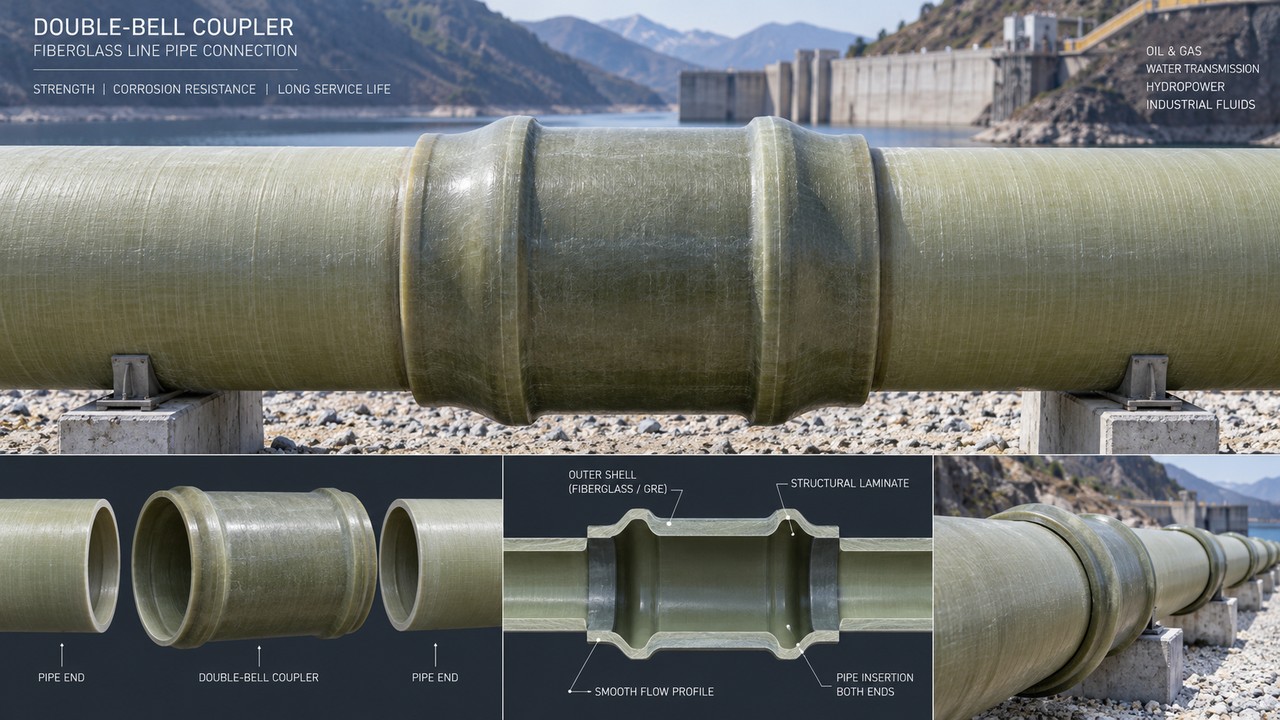
When your RFQ names a double bell coupler joint for fiberglass (GRE/FRP) line pipe, you are specifying a non-restrained coupler for compatible pipe ends—not a rubber-seal spigot or locked joint. You lock diameter and pressure (up to 4,000 mm / 40 bar), thrust blocks or hybrid systems, burial versus hydropower aboveground, and any testable joint need before IFGS in Dongying quotes. This page shows what to put in your inquiry so your quote matches the joint you need.
What a double bell coupler joint means on your RFQ
On the IFGS product page, a Double Bell Coupler Joint joins compatible fiberglass pipe ends. You specify dimensions, service conditions, and pipeline layout so seals, movement limits, and thrust management can be confirmed together. Published bullets list: up to 4,000 mm with pressure up to 40 bar; a non-restrained joint with high flexibility and deflection that requires thrust blocks or hybrid systems; typically buried use, with hydropower that may utilize aboveground installation; and availability with a testable joint configuration.
A technical datasheet is not published on the product page—you request the applicable dimensions, ratings, and supporting documents for your project. For your primary product path, open Double Bell Coupler Joint.
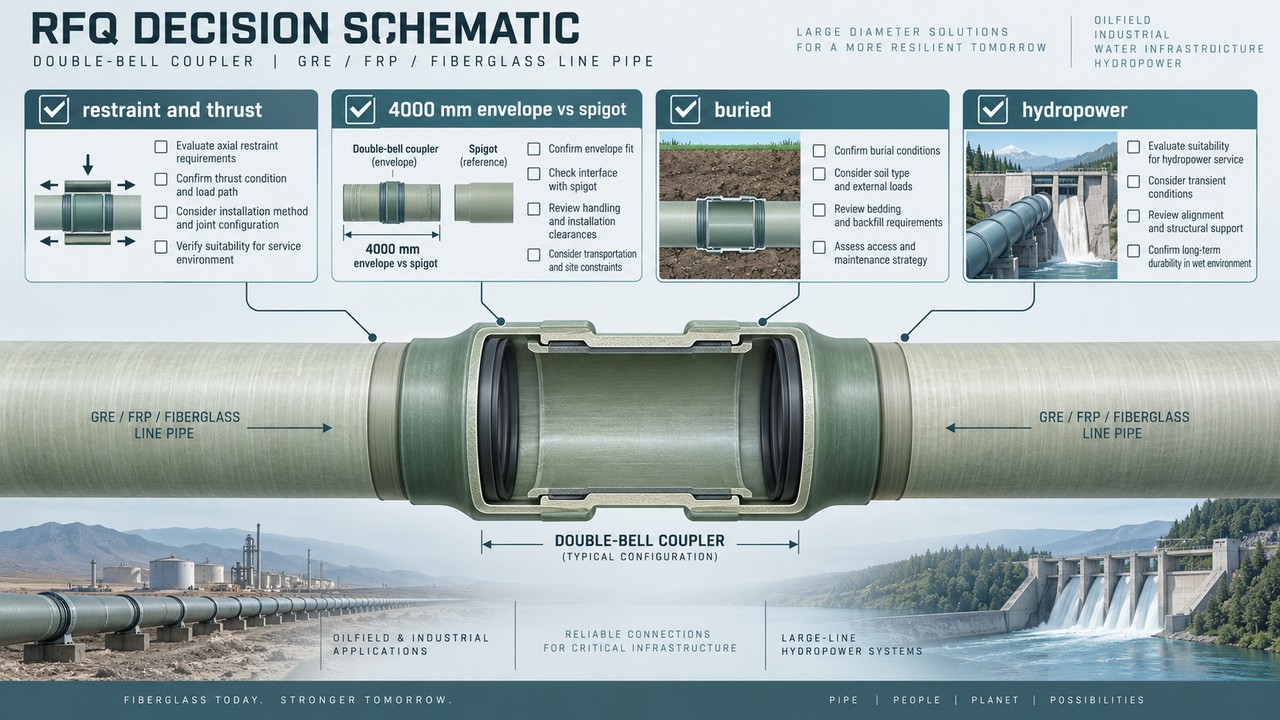
Spec decisions your RFQ should name
Use this table when you shortlist a double-bell coupler on restraint, size, and documents:
| Decision factor on your project | What IFGS publishes (reference) | What you should put in your RFQ |
|---|---|---|
| Joint type | Double-bell coupler for compatible fiberglass pipe ends | Name double-bell coupler (not spigot-only or locked) |
| Size / pressure envelope | Up to 4,000 mm; pressure up to 40 bar | Target OD and design/operating pressure with units |
| Restraint | Non-restrained; high flexibility and deflection; requires thrust blocks or hybrid systems | Confirm thrust-block or hybrid plan at bends, tees, dead ends |
| Installation | Typically buried; hydropower may utilize aboveground | Buried vs aboveground sections; hydropower flag if any |
| Testable config | Available with testable joint configuration | State whether you require a testable joint |
| Sister compare (non-restrained) | Rubber-seal spigot: up to 1,400 mm / 50 bar; thrust blocks/hybrid | Say why double-bell (larger OD envelope) vs spigot |
| Sister compare (restrained) | Locked spigot: up to 1,400 mm / 50 bar; does not require thrust blocks | Flag if your layout cannot use thrust blocks |
| Selection checklist | Application; dimensions/connections/materials; quantity and documents; “Not sure yet” OK | Mark undecided fields; partial information is enough to start |
When you need the sister non-restrained path at smaller diameter, review Fiberglass Rubber-Seal Bell & Spigot Joint. When your layout needs restraint without thrust blocks, review Rubber Seal Bell And Spigot Locked Joint. Treat published scope figures as catalogue limits and request the datasheet for the exact configuration offered.
RFQ checklist: what you should send so the quote matches your joint
Before you request a quotation, include these items:
- Intended application and service environment — GRE/FRP line duty; buried or hydropower aboveground; operating conditions that affect selection.
- Dimensions, connections, and material requirements — pipe OD/ID targets; coupler quantity; share a drawing or project specification if available.
- Pressure and temperature with units — design and operating pressure against the published up to 40 bar envelope; temperature window.
- Thrust-management arrangement — thrust blocks, hybrid systems, or a note that you are comparing a restrained sister joint.
- Testable joint configuration — yes / no / not sure yet.
- Quantity, delivery destination, and delivery window — enough for a Dongying quotation.
- Ask for technical documents by name — product datasheet, connection information, and qualification documents; the team confirms availability and applicable version.
Include what you know and mark undecided fields as “Not sure yet”—partial information is enough to start.
Where the double-bell coupler fits on your joint scope
You shortlist a double-bell coupler when your fiberglass line needs a non-restrained mechanical joint in a large-diameter envelope (published up to 4,000 mm / 40 bar), with flexibility and deflection managed by thrust blocks or hybrid systems. Open Double Bell Coupler Joint first. Use Fiberglass Rubber-Seal Bell & Spigot Joint for the 1,400 mm / 50 bar non-restrained spigot path, or Rubber Seal Bell And Spigot Locked Joint when you need restraint without thrust blocks. For the non-restrained family, open Mechanical Non-Restrained Joints.
Spec traps that slow your quote
You should watch for these gaps—they usually return clarifying questions instead of numbers:
- You wrote “coupler” or “joint” but skipped diameter, pressure, and whether the joint is non-restrained.
- You treated 4,000 mm / 40 bar as a combined guaranteed rating for every size instead of requesting the offered configuration.
- You mixed rubber-seal spigot language (1,400 mm / 50 bar) into a double-bell inquiry without stating which product path you need.
- You omitted thrust blocks or hybrid systems on a non-restrained layout—or asked for no thrust blocks without switching to a restrained sister.
- You asked for price only and skipped the datasheet, connection information, testable-joint flag, and qualification documents.
- You omitted quantity, delivery destination, and delivery window needed for quotation.
Clean those gaps—your inquiry is ready.
FAQ
What does a double bell coupler joint mean for your RFQ?
For your inquiry, a double bell coupler joint is an IFGS non-restrained coupler for compatible fiberglass pipe ends. You specify dimensions, service conditions, and pipeline layout so seals, movement limits, and thrust management can be confirmed together. Name double-bell coupler clearly so your quote follows the large-diameter coupler path—not a rubber-seal spigot or locked joint alone.
What size and pressure envelope should you check first?
On the live Double Bell Coupler Joint page, published scope lists up to 4,000 mm and pressure up to 40 bar. You should treat those figures as catalogue limits for your shortlist—not as a combined inspection rating for every diameter and duty. Ask IFGS for the exact configuration offered against your OD, design pressure, and layout.
Why does your layout need thrust blocks or a hybrid system?
The product page classifies the joint as non-restrained, with high flexibility and deflection, and states that it requires thrust blocks or hybrid systems. You should describe how thrust is carried at bends, tees, and dead ends on your pipeline. If your project cannot use thrust blocks, compare the restrained locked-spigot sister before you freeze the inquiry.
How does the double-bell coupler differ from a rubber-seal spigot on your RFQ?
You use the double-bell coupler path for the published large-diameter envelope (up to 4,000 mm / 40 bar). The rubber-seal bell-and-spigot sister is published up to 1,400 mm / 50 bar and is also non-restrained with thrust blocks or hybrid systems. State which envelope and joint form your line list needs so IFGS does not quote the wrong product family.
When should you compare a locked (restrained) spigot instead?
You should compare Rubber Seal Bell And Spigot Locked Joint when your layout needs restraint with flexibility and does not require thrust blocks. That sister is published up to 1,400 mm / 50 bar. Keep double-bell coupler on your RFQ when you need the larger non-restrained coupler envelope and can plan thrust blocks or a hybrid system.
What does “testable joint configuration” mean for your inquiry?
The live page states the double-bell coupler is available with a testable joint configuration. You should say whether your project requires that option, mark “Not sure yet” if undecided, and ask IFGS to confirm the offered arrangement in the datasheet and connection information. Clear language here avoids a quote that omits a test feature your inspection plan expects.
What should you attach when you ask IFGS for a quotation?
You should attach intended application and service environment; dimensions, connections, and material requirements; pressure and temperature; thrust-management notes; testable-joint preference; quantity and required documents; plus quantity, delivery destination, and delivery window. Ask for the product datasheet, connection information, and qualification documents by name so the team can confirm availability and the applicable version.
When your checklist is complete, open the Double Bell Coupler Joint page linked above, request the datasheet and connection information for the configuration that fits your line, and send IFGS your dimensions, pressure, thrust plan, testable-joint flag, standards, quantity, and delivery window. That package lets your double-bell coupler quote rest on verified technical data for your service—not guesswork.