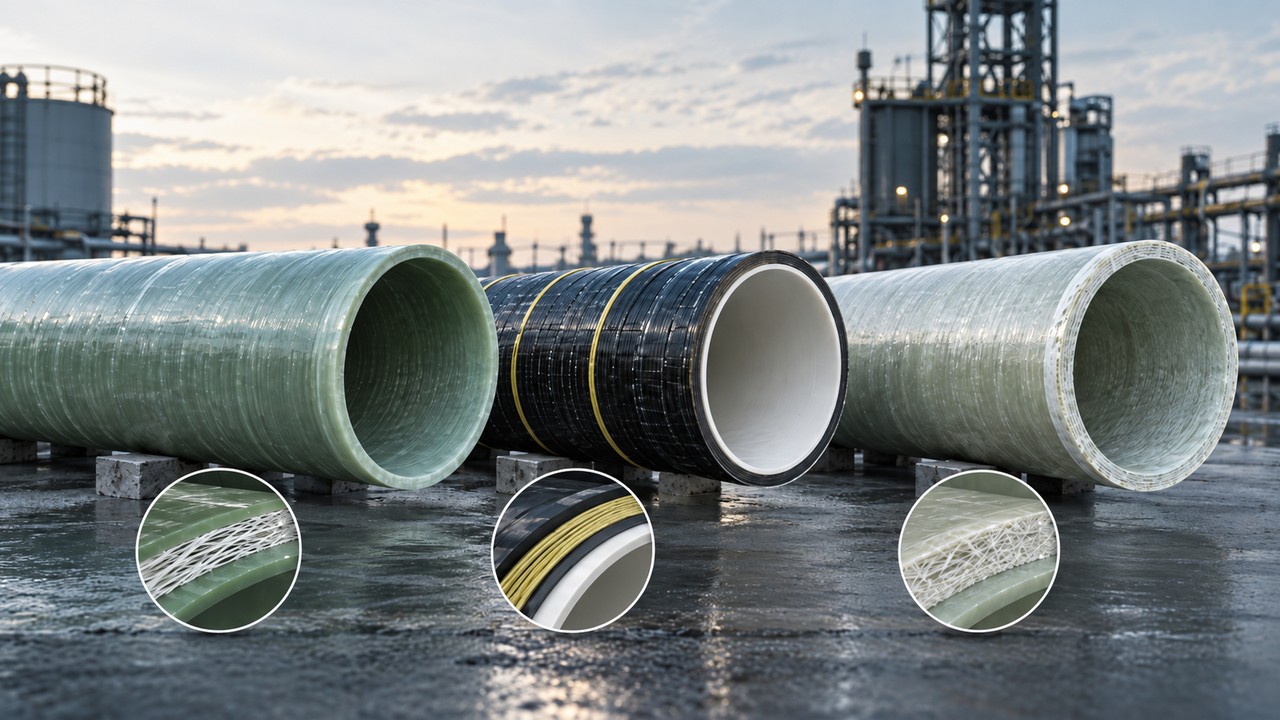
When your RFQ names non-metallic pipes, you are choosing a corrosion-resistant GRE, FRP, RTP, or related composite line for oilfield or industrial duty—not a glossary term. Where steel corrodes early in produced water, injection, or chemical service, that choice steers family, pressure and temperature, dimensions, and connections before you ask IFGS for a datasheet. This page shows what to lock into your inquiry so your quote matches the family you need.
What non-metallic pipes mean on your line RFQ
On IFGS pages, non-metallic pipes is a product family that groups GRE tubing, GRP pipe, reinforced thermoplastic pipe, flexible composite options, and related listings. You should treat it as a selection decision: name fluid, design pressure, temperature, dimensions, and connections, then ask for the datasheet that confirms ratings for that duty.
The category invites you to compare products and open catalogues and technical resources for a selection checklist. Listed cards include API 15HR GRE Tubing (DN40–DN100; 10 MPa–25 MPa), Flexible Composite Pipe For High Pressure Transmission (DN40–DN200; 2.5 MPa–32 MPa), GRE Tubing, GRP Pipe, Offshore Flexible Composite Flowline & Riser (Shallow Water), Onshore API 15S RTP Pipe (buyer spec frame API Spec 15S; project PO governs), PFP Pipe, and Reinforced Thermoplastic Pipe. Treat catalogue ranges as reference—not as a combined inspection rating for every duty.
For your primary family path, open Non-metallic pipes.
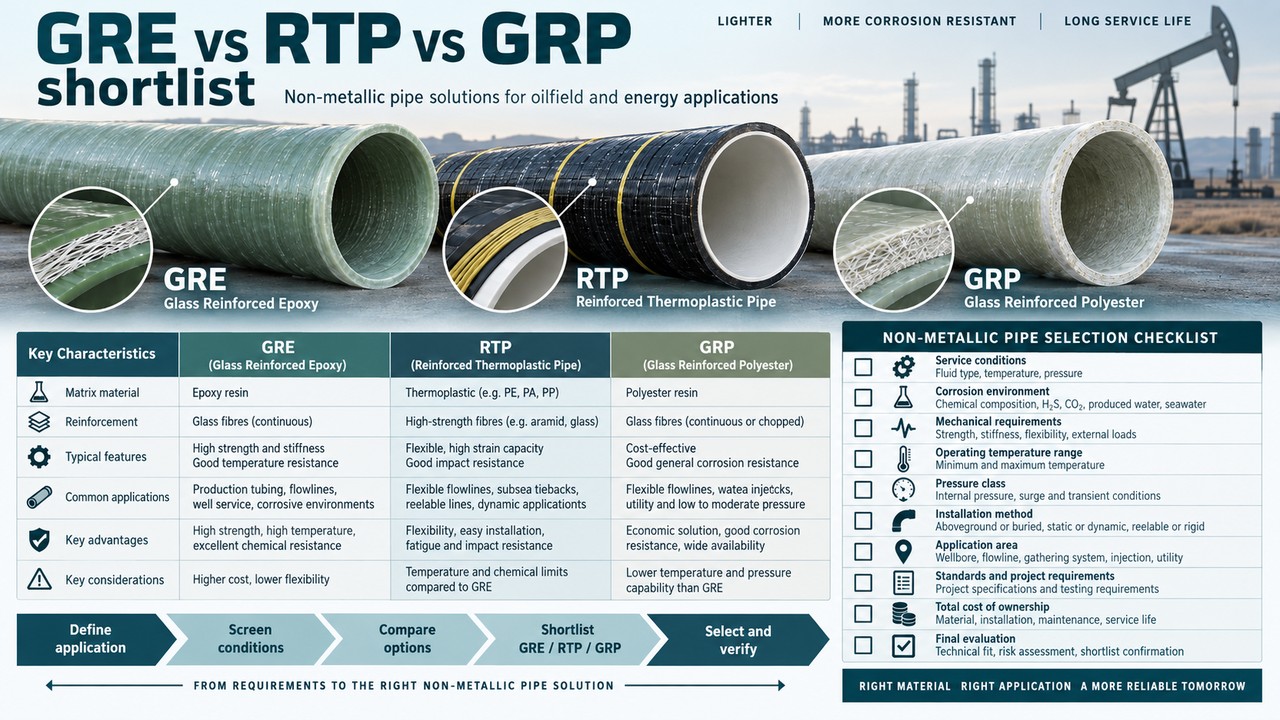
GRE vs RTP vs GRP: what your RFQ should name
Use this table when you shortlist family against fluid, pressure, temperature, and installation:
| Decision factor on your project | What IFGS publishes (reference) | What you should put in your RFQ |
|---|---|---|
| Family shortlist | GRE Tubing; Reinforced Thermoplastic Pipe; GRP Pipe; related flexible/API 15S cards | Name GRE, RTP, GRP, or another listed family |
| GRE tubing duty | Project-specific well applications; request configuration-specific datasheet | Well arrangement, fluid, temperature, pressure, connections |
| RTP duty | Project-specific fluid transfer; define fluid, pressure, temperature, dimensions, end connections | Fluid/composition, P–T, dimensions/route, end fittings; coiled supply confirmations if proposed |
| GRP duty | Water and industrial piping; select resin, dimensions, joints, installation against service fluid | Service fluid, resin path, dimensions, joints, installation arrangement |
| Catalogue / API scope myth | API 15HR/15LR industry scope tables on GRE pages are industry-published ranges, not IFGS product ratings | Request IFGS datasheet ratings for your submitted duty |
| Spec frame on onshore RTP card | API Spec 15S (project PO governs) | Name the PO/spec frame you will audit |
When your scope needs GRE tubing for well duty, review GRE Tubing. For spoolable or thermoplastic transfer, review Reinforced Thermoplastic Pipe. For water or industrial GRP piping, review GRP Pipe. Treat family cards as starting points and request the datasheet for the exact configuration offered.
RFQ checklist: what you should send so the quote matches your line
Before you request a quotation, include these items:
- Duty and fluid — oilfield, geothermal, or industrial; produced water, injection, chemical, water, or other; share chemistry you can.
- Family preference — GRE, RTP, GRP, flexible composite, or “not sure yet” against the category cards.
- Design pressure and temperature — operating and design values with units; flag surge if known.
- Dimensions and length — diameter, route or useful length; continuous lengths if flexible/RTP applies.
- Connections and installation — end connections, drawings, installation arrangement, handling needs.
- Standards / PO frame — e.g. API Spec 15S on the onshore RTP card, or other project documents you must satisfy.
- Quantity, delivery window, and destination — enough for an IFGS quotation.
- Ask for the datasheet by name — verified dimensions, ratings, and supporting documents; if coiled supply is proposed, confirm coil dimensions, handling, and bend radius.
Include what you know and mark undecided fields honestly—partial information is enough to start a technical discussion.
Where non-metallic pipes fit when steel corrodes
IFGS sources GRE and FRP systems from licensed partner factories in China and worldwide and handles spec confirmation, procurement and pre-shipment QC for oil and gas, geothermal, and industrial lines where steel corrodes. You shortlist non-metallic pipes for produced water, injection, or chemical service when you can name fluid, pressure, temperature, dimensions, and connections. Open Non-metallic pipes first, then deepen into GRE Tubing, Reinforced Thermoplastic Pipe, or GRP Pipe once duty is clear.
Spec traps that slow your quote
You should watch for these gaps—they usually send a non-metallic pipes RFQ back with clarifying questions instead of numbers:
- You wrote “non-metallic pipe” but skipped fluid, design pressure, temperature, dimensions, and connections.
- You mixed GRE, RTP, and GRP language without stating which family to confirm.
- You treated API industry scope tables or catalogue ranges as IFGS product ratings instead of requesting the datasheet.
- You proposed coiled RTP supply without coil dimensions, handling, and bend radius confirmation.
- You asked for price only and skipped the datasheet request the product pages invite.
Clean those gaps—your inquiry is ready to quote.
FAQ
What does “non-metallic pipes” mean for your line RFQ?
For your inquiry, non-metallic pipes means the IFGS product family that groups GRE tubing, GRP pipe, reinforced thermoplastic pipe, flexible composite options, and related cards. On the category page, you compare products and share fluid, design pressure, temperature, dimensions, and connections. Name duty and preferred family so the quote matches the datasheet path you need—not a vague “nonmetallic” label alone.
When should you choose GRE tubing versus RTP versus GRP?
Choose GRE Tubing when your well or pipeline duty needs glass-reinforced epoxy and you can share well arrangement, fluid, temperature, pressure, and connections. Choose Reinforced Thermoplastic Pipe when you need project-specific fluid transfer and can define fluid, pressure, temperature, dimensions, and end connections. Choose GRP Pipe for water and industrial piping where you select resin, dimensions, joints, and installation against the service fluid. You should state which path you want confirmed.
What catalogue ranges appear on the non-metallic family cards?
On the live category page, API 15HR GRE Tubing lists DN40–DN100 and 10 MPa–25 MPa; Flexible Composite Pipe For High Pressure Transmission lists DN40–DN200 and 2.5 MPa–32 MPa. You should treat those figures as catalogue reference on the family cards—not as a combined inspection rating for every size and duty. Ask IFGS for verified dimensions and ratings for the configuration offered against your submitted conditions.
Are API 15HR/15LR scope tables IFGS product ratings?
No. On the GRE Tubing page, IFGS states that API Spec 15HR/15LR industry scope tables are industry-published ranges for the material class—they are not IFGS product ratings. You should request the IFGS datasheet for pressure, temperature, and dimensions applicable to your submitted duty rather than treating industry scope numbers as your string rating.
What should you attach when you ask IFGS for a quotation?
You should attach duty and fluid, preferred family, design pressure and temperature, dimensions and length, connections and installation details, standards or PO frame you will audit, plus quantity, delivery window, and destination. Ask for the product datasheet by name. Where coiled supply is proposed on an RTP path, confirm coil dimensions, handling requirements, and allowable bend radius with the supplier before you freeze logistics language.
Can you use brochure family cards as your inspection basis alone?
No. Category and product pages present family cards and selection prompts so you can compare options and request technical data. You should treat published ranges and industry scope tables as directional reference and request verified technical documents for the exact configuration offered before you lock inspection language into your RFQ.
Where do you start if you are still unsure which family fits?
Start on the Non-metallic pipes category: share fluid, design pressure, temperature, dimensions, and connections, and open technical resources if you need a selection checklist. You can mark family preference as undecided. IFGS pages state partial information is enough to start a technical discussion—then deepen into GRE Tubing, Reinforced Thermoplastic Pipe, or GRP Pipe once your duty is clearer.
When your checklist is complete, open the Non-metallic pipes category linked above, request the datasheet for the family that fits your duty, and send IFGS your fluid, pressure and temperature, dimensions, connections, standards or PO frame, quantity, and delivery window. That package lets your non-metallic pipe quote rest on verified technical data for your line—not guesswork.