When your artificial-lift RFQ names a fiberglass sucker rod, you still need rod format, reinforcement, well depth, expected load, pumping-system arrangement, and connections before a quote can land. You confirm whether you want jointed fiberglass rods or a continuous composite rod, mark undecided fields “Not sure yet,” and request the dimensions and load data for the exact configuration offered. This page is a rod-string RFQ/spec checklist, with the design limits and rod formats that shape it.
What a fiberglass sucker rod covers on your RFQ
On the live IFGS product page, sucker rod selection depends on three things: reinforcement, rod format, and the pumping system. IFGS asks you to confirm whether your requirement is for jointed fiberglass rods or continuous composite rod before you request the applicable dimensions and load data. Your search term may say “fiberglass,” but your RFQ has to say which format and which reinforcement you actually need.
The IFGS sucker rod family covers fiberglass and carbon-fiber continuous rod products for artificial-lift wells where corrosion or weight motivates a non-metallic rod string. A technical datasheet is not published on the product page, so you request the applicable dimensions, ratings, and supporting documents for your project. For your primary quote path, open Fiberglass Sucker Rod.
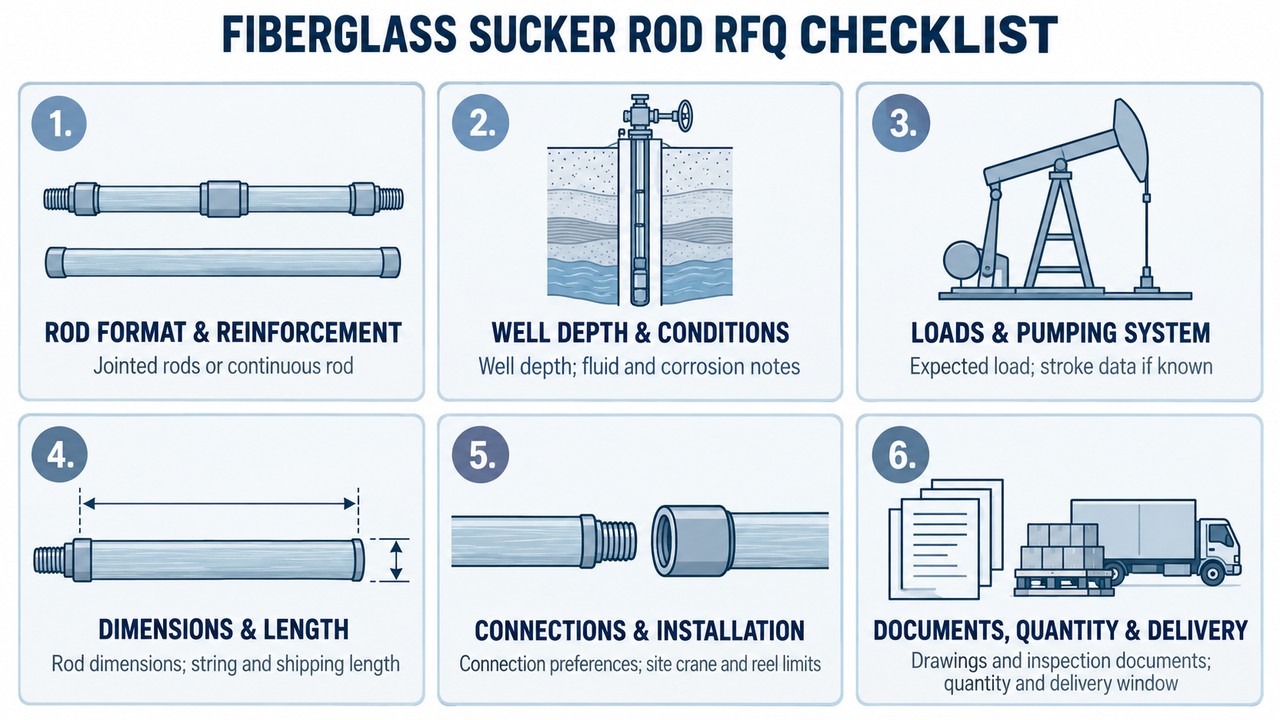
Spec decisions your RFQ should name
Use this table when you shortlist a fiberglass or composite sucker rod on format, well data, loads, length, connections, and documents:
| Decision factor on your well | What IFGS publishes (reference) | What you should put in your RFQ |
|---|---|---|
| Rod format | Confirm jointed fiberglass rods or continuous composite rod | Name the format you need—or mark it “Not sure yet” |
| Reinforcement | Selection depends on reinforcement; family covers fiberglass and carbon-fiber continuous rod | State the reinforcement material you require or will accept |
| Well data | RFQs should include well depth and fluid/corrosion notes | Well depth, produced fluid, and corrosion history on the well |
| Loads and pumping system | Selection depends on loads and pumping-system arrangement | Expected load, stroke data if known, and pumping-system use |
| Dimensions and length | Request applicable dimensions; state required length | Rod dimensions, required length, and preferred shipping length |
| Connections and installation | Include connections, interfaces, and installation equipment | Connection preferences plus site crane or handling limits |
| Ratings | No datasheet published on the page; confirm conditions behind any published rating | Ask for the conditions and documents that apply to the offered rod |
| Documents | Drawing, technical data, inspection documents; datasheet, connection and qualification documents | Ask by name; add quantity, destination, and delivery window |
When your well calls for a reeled, one-piece string rather than jointed rods, you compare the continuous option on Fiberglass and carbon fiber continuous sucker rod, where IFGS asks you to confirm the reinforcement material, rod dimensions, operating loads, and installation equipment. Keep one format per RFQ line so your loads, length, and handling notes stay on one path.
RFQ checklist: what you should send so the quote matches your well
Before you request a quotation, include these items:
- Named product path — Fiberglass Sucker Rod — and whether you need jointed fiberglass rods or continuous composite rod.
- Reinforcement material — fiberglass, carbon fiber, or the reinforcement your design basis requires; mark it “Not sure yet” if open.
- Well depth and well conditions — depth, produced fluid and corrosion notes, and corrosion history on the well.
- Expected load and pumping-system arrangement — rod-string load, stroke data if known, and how the pumping system will run the rod.
- Operating temperature — with units, plus the service medium and environment.
- Rod dimensions and length — rod size, required string length, and preferred shipping length.
- Connections and interfaces — connection preferences and the interfaces the rod must match.
- Installation equipment and site limits — installation equipment available, and site crane limits when they constrain a reel or coil.
- Standards and approvals — any project standard and edition your tender names; ask IFGS which documents apply to the offered rod. Fiberglass (FRP) sucker rods are covered by API Spec 11B, which includes an annex for FRP sucker rods and pony rods (28th edition, December 2023); the older API Spec 11C for reinforced plastic sucker rods is withdrawn. If your tender still cites API 11C, ask which edition of API 11B applies instead. Do not label sucker rods API 15S, 15HR or 15LR: those are fiberglass and spoolable pipe specifications. IFGS does not state API 11B conformance or an API Monogram for these rods; ask for the documents that apply to the offered rod.
- Quantity, delivery destination, and delivery window — plus documents by name: drawing, technical data, inspection documents, product datasheet, connection information, and qualification documents; the team confirms availability and version.
Mark undecided fields as “Not sure yet”—partial information is enough to start a technical discussion. If you are still defining your specification, you start with a technical review; if you have a purchase requirement, you request a quote. If your tender mixes rods with tubing or casing, split the RFQ—different document packs apply.
Where a fiberglass sucker rod fits on your artificial-lift scope
You shortlist the Fiberglass Sucker Rod when corrosion or rod-string weight is pushing your well away from an all-steel string, and you can state well depth, expected load, fluid and corrosion notes, and connection preferences well enough for review. You move to the continuous composite rod when your design calls for one-piece reeled rod and your site can handle the reel or coil. Continuous rod logistics differ from stick rod, so you name crane and handling limits early. You treat any figure IFGS sends as tied to stated conditions, not as a blanket rating for every well.
Limits your rod-string design plans around
A fiberglass rod section changes how your string behaves, so your design has to account for four limits before you ask for load data:
- Keep the composite section in tension. Fiberglass rods are not meant to carry compression. Rod-string designs usually place steel rods or steel sinker bars at the bottom of the string so their weight keeps the fiberglass section in tension and the steel section takes the downstroke compression.
- Plan for stretch. Fiberglass rods stretch considerably more than steel under the same load. Pump stroke and spacing belong in your string design, not in a catalogue figure.
- Respect the resin temperature limit. The resin system sets the operating temperature, and rod capacity falls as temperature rises. Send your downhole temperature at pump depth so the supplier can confirm the resin system against it.
- Follow composite handling rules. Improper handling can damage a composite rod body. Ask for the handling and make-up instructions for the offered rod and plan your rig and storage around them.
Jointed fiberglass vs continuous composite vs steel rod
This is a qualitative comparison only, with no ratings:
- Jointed fiberglass rod: fixed-length rods with end fittings, made up joint by joint with conventional rod handling. Corrosion-resistant body and a lighter string, usually run as the upper or middle section of a hybrid string with steel below.
- Continuous composite rod: one long rod without intermediate couplings, run and pulled with dedicated installation equipment. IFGS lists fiberglass and carbon-fiber options. Fewer connections in your well, but the installation equipment and rod length go into your RFQ and service access has to be planned.
- Steel rod: the familiar baseline. It takes compression and tolerates temperature better than resin, but it is heavier and corrodes in aggressive fluids. It remains the usual choice for sinker bars and the lower string.
Spec traps that slow your quote
You should watch for these gaps—they usually return clarifying questions instead of numbers:
- You wrote “fiberglass sucker rod” and never named jointed or continuous format.
- You left reinforcement material open while asking for load data.
- You sent rod size only, with no well depth or expected load.
- You skipped fluid and corrosion notes or the corrosion history on the well.
- You omitted stroke data or pumping-system use that you already know.
- You ordered continuous rod without site crane or reel handling limits.
- You assumed a published datasheet; the product page states none is published, so you request it.
- You asked for price only and skipped quantity, destination, delivery window, and the document list.
Clean those gaps—your inquiry is ready.
FAQ
What should you define before IFGS can review your sucker rod RFQ?
You should define rod format and reinforcement, well depth, expected load, fluid and corrosion notes, and your pumping-system arrangement. Add connection preferences, installation equipment, and any site crane limits, plus a drawing or project specification if you have one. Partial information is enough to start a technical discussion. Mark undecided fields “Not sure yet” so your review can begin without guessing at loads or length.
Does IFGS mean jointed fiberglass rods or continuous composite rod?
The product page asks you to confirm which one your requirement covers before you request dimensions and load data. The sucker rod family also lists fiberglass and carbon-fiber continuous rod for artificial lift. Your search may start with “fiberglass,” but your RFQ should name the format and reinforcement material you need, so the offer matches your well and your installation equipment rather than a catalogue image.
Is a fiberglass sucker rod datasheet published on the product page?
No. The live product page states that a technical datasheet is not published there. You request the applicable dimensions, ratings, and supporting documents for your project, together with the drawing and technical data for the exact configuration offered. Before you order, confirm material compatibility, dimensions, connection details, and the conditions applicable to any published rating, so your string design rests on documents tied to your rod.
What well data should you send with your inquiry?
You should send well depth, produced fluid and corrosion notes, corrosion history on the well, and stroke data if you know it. Add expected load, operating temperature with units, and how your pumping system will run the rod. IFGS notes that operators need numbers and handling limits, so concrete well data lets the team propose a rod configuration instead of returning a list of questions.
Can your whole rod string be fiberglass?
Usually not. Fiberglass rods should stay in tension, so rod-string designs usually run steel rods or sinker bars below the fiberglass section. Your rod-string design decides the fiberglass share, the steel section and the sinker bar length. Send your well depth, pump setting depth, pumping unit and expected loads so the supplier can review the string with you rather than quoting a rod in isolation.
Why do reel and crane limits matter for continuous rod?
Continuous rod logistics differ from stick rod, and IFGS asks you to call out site crane limits when they constrain the reel or coil. You should state your preferred shipping length, the installation equipment you have on site, and any access constraints. That lets your supplier match string length and packaging to your handling capacity, so your delivery plan works at the wellhead as well as on paper.
What should you attach when you ask IFGS for a sucker rod quotation?
You should attach rod format and reinforcement; well depth and conditions; expected load and pumping-system use; rod dimensions, required length, and preferred shipping length; connection and installation requirements; plus quantity, delivery destination, and required delivery window. Ask for the drawing, technical data, inspection documents, product datasheet, connection information, and qualification documents by name—the team confirms availability and the applicable version for your project.
When your checklist is complete, open the Fiberglass Sucker Rod page linked above (or the continuous composite rod when your well needs a reeled string), and send IFGS your rod format, reinforcement, well depth, expected load, pumping-system use, length, connections, quantity, and delivery window. Ask for the drawing and technical data for the exact configuration offered. That package lets your rod quote rest on verified well fields—not guesswork.